Emperor Profile: Qin Shihuang- First Emperor of China: 秦始皇短记
.jpg)

This is an excerpt from a larger series regarding various noted Chinese emperors. This short segment in particular briefly covers the context of Qin Shihuang the First Emperor of Qin.
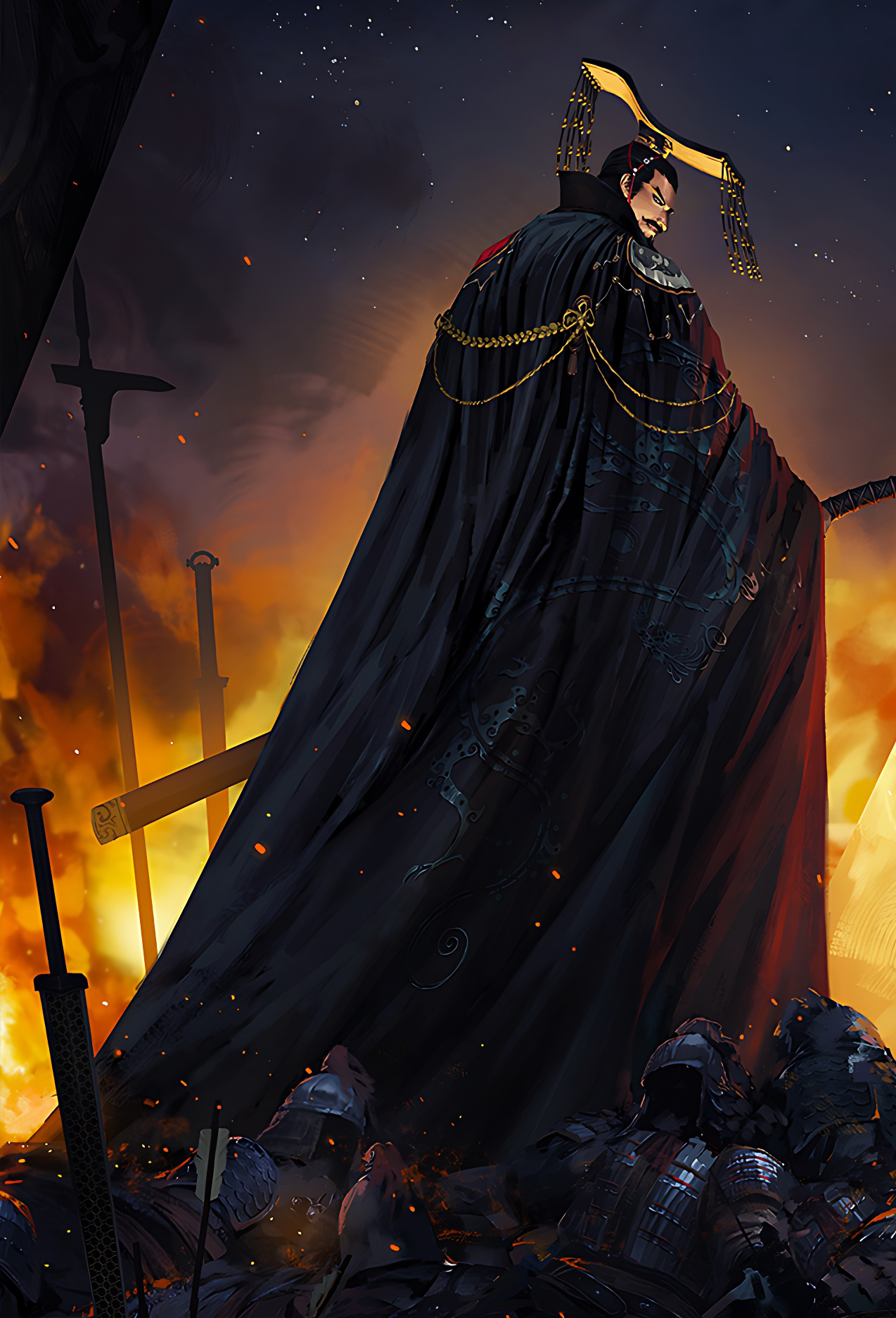
Art (Below) by 果Z
Music: 无衣 (Without Uniform)
THE FIRST EMPEROR- QIN SHI HUANG
THE SPARE

The young King of Qin- Ying Zheng ascended the throne merely at the age of 13. He was born at an immensely important tipping point in Qin- and Warring State era's history. Through rapacious conquest and decade of warmongering (such as under the legendary general Bai Qi,) his formidable great- grandfather King Zhaoxiang turned Qin from a strong regional hegemon in the west to become the indisputable greatest military state of the realm.

.jpg)
Zhaoxiang's 57-year reign saw critical territorial expansions, including the brazen mask- off destruction of the Eastern Zhou court and breaking the backs of Chu and Zhao- 2 of the greatest peers against Qin supremacy in battle. However his later rule saw much of the early gains lost. Zhaoxiang's long life meant that when he passed- his son was only able to rule very briefly before he too passed due to old age. The vacant throne was then passed to Ying Zheng's father- a truly unexpected fringe candidate for the throne. Ying Zheng's father had been a hostage at Zhao (at the time Ying Zheng's father was merely a fringe son his own father- Ying Zheng's grandfather was hopelessly in love with his childless favorite wife.) It was at Zhao, that a ruthlessly ambitious merchant named Lu Buwei convinced the exiled prince with a ploy to become the sole heir to the kingom: by 1st become the adopted son of the favorite wife, then sire a promising son to secure his position in the chain of succesion. The ploy worked and Ying Zheng as born, engineered to take on the royal mantle, and when the throne briefly passed to Ying Zheng's father, he gratefully elevated Lu Buwei to become the Chancellor despite Lu's unseemly origins as a merchant.
%20LATE%20Q.png)
The early death of his father meant that much of the true reins of power was left to great regents like Lu Buwei and other ministers. And the tipping point rested on the question if the largely sheltered youth would take up the old rein of finishing up the unification effort or walk a different path.
Authorial insert- the realm was once under the sway of one royal dynasty already- that of the Zhou- and by this point the realm is largely a tripartite cluster- if not for Qin, then Zhao, or Chu- who each had spent centuries annexing their smaller neighboring states and harbored grand ruthless ambitions, these states also would not have any qualms about some level of unification. Modern history- especially recently with the likes of Extra History's recent very liberal take on the First Emperor missed the the name of the game of the period: that it was going to be an inevitable whirlpool of a Battle Royale toward unification and 1 survivor standing regardless between the eponymous "Warring States." Doubt my words? Just check out the many litanies of failed coalitions before this era which nearly all ended with backstab or one of the coalition's vaunted leaders abandoning others.
Music: Ode of the Qin

Ying Zheng grew up with a strange mix of personal obstacles and deep well justified insecurities because his position is largely an engineered creation of Lu Buwei who won the seat for his father. As such, young Ying Zheng's rein was well under the shadow of his Chancellor. His mother, the influential Queen Dowager Zhao's position at court was also owed entirely to Lu Buwei: thus both pillars: Lu and his mother- had little interest in the boy become too autonomous. After Ying Zheng became a man- a eunuch who serve his mother named Lao Ai attempted a coup against the young King's rule. The conspiracy was deeply scandalous- as it was uncovered that the Lao Ai- despite being a "eunuch" was in fact not castrated- and in fact had been a lover of his mother for decades- what's more they had behind the king's back produced 2 illegitimate children to replace him once he was killed. Nothing was it seemed and the poisoned barb was harbored and sanctioned by none other than his mother and her lover "eunuch." Ying Zheng reacted grimly, the dowager queen was imprisoned, Lao Ai and his 2 illegitimate siblings were executed, and Lu Buwei was removed from power- later he committed suicide in his exile. After internal consolidation, the Qin again turned its attention abroad,
THE UNIFICATION WAR

Born to (not) rule. Ironically the boy who would style himself the First Emperor along a Daoist sage king's stripes was once merely a spare. Conspired to be murdered by none other than his mother and her lover and replaced, Ying Zheng defied all odds and multiple assassination attempts to become a grim autocrat that finally overawed the rest of the 6 kingdoms.


Unlike the long drudging campaigns conducted by his great- grandfather which spanned and politicked across some 5+ decades, under the planning of Ying Zheng and capable generals like Wang Jian, Wang Ben and Meng Tian, this time the Qin overwhelmed the 6 remaining kingdoms in only 1 decade with multiple battles of annihilations and systemic follow-through. In a relatively rapid succession- the kingdoms of Han, Zhao, Wei and Chu all fell- and once Chu- the most powerful peer of Qin fell under a Qin invasion which composed over half a million soldiers for a prolonged campaign, Qin unification became inevitable. After a brazen Yan assassination attempt against Ying Zheng that came the closest to taking his life failed- Yan was also annexed, and at last, Qi, the only remaining state that largely placated Qin at every turn was left, when Qin marched into its land, Qi surrendered as well.

Finally Qin unified the realm under 1 throne. To ensure the stability and integration of the new realm, the Qin abolished the nobility of the other 6 states (Qin itself had long did so under the Legalist Shang Yang centuries before- turning the realm into a meritocratic state for both military and civilian officialdom) . Units and measurements, along with writing scripts and law was standardized across the realm under the minister Li Si. Unlike his predecessors, who bore only the title of Wang 王 which meant "King" Ying Zheng took up a newly consecrated title of "Emperor" or huangdi 皇帝 which had daoist connotations of ancient sagely deities.
Perhaps tellingly. Qin was said to have melted down swords and weapons from its foes and then forged them into great statues in the Qin capital.
Having unified the interior of China proper- the First Emperor then embarked on a grand series of engineering projects to secure the realm against external threats- inaugurating the linkage of the Great Walls under 1 unified spine and sending forays north and south. Though a legalist, the Inscriptions of Langya Stele 琅琊刻石- erected shortly after his completion of the unification wars was extolled Confucian outlook to peace, prosperity, harmony and propriety- as well as striving for the cosmic virtuous of the Daoist way.

"...Now, the Emperor has unified the whole country and made it into prefectures and counties. The world is at peace. He has made the ancestral temples bright, embodied the Way (Dao) and practiced virtue, and his title has been greatly honored. The ministers recite the Emperor's merits and virtues together and have them engraved on metal and stone as a record."
- Qin Inscriptions of Langya Stele

Unfortunate for Qin- (and fortunate to those who felt disempowered by it as well as its old rivals) Qin Shihuang did not live to truly old age- he died before reaching the age of 50 at 49 during a tour of the realm and his megalomaniacal empire- which saw nearly half a millennium of preparation by his patient ancestors- was undone in 1 decade after.


➢ ☯ Futsunomitama
➢ ☯ MK Celahir
➢ ☯ Muramasa
➢ ☯ Thomas Vieira
➢ ☯ BurenErdene Altankhuyag
➢ ☯ Stephen D Rynerson
➢ ☯ Peter Hellman
➢ ☯ SunB


Comments
https://dragonsarmory.blogspot.com/2026/02/chinese-emperors-portrait-gallery.html
but here is the full quote.
If Qin had lasted generations beyond after its founding unifier- it would have certainly been remembered to better lights- and likely something akin to that of Sargon of Akkad, Genghis Khan, -at least by their own people.
Yes, too much, too soon, and too soon unravelled.
As grim and excessive (to the other kingdom's subjects and nobles as Qin was- it was too soon to reasonably consolidate an empire. Zhou sort of vaguely faced similar situations with the swift death of King Wu only 3 years after he crushed the Shang and triggering a massive revolt from all stripes. The problem with Qin was that within the court instead of vesting power upon an otherwise capable prince- Fusu- known to be both capable, humane, and still young and energetic, the court had him framed with forced suicide then the inner court was taken over by devious schemers over a clueless 2nd emperor. For these reasons even if the outside did not rebel the internal matters looked grim regardless. This is not to say that perhaps the framing of them as villainous ministers is too accurate- after all such instances did exist- for example say- Louis 14th and Louis 15th minority were all ruled over by elder regents who provided crucial in keeping things running while the young sovereign grew up. Given it was rumored with some credibility Louis 14th's mother Anne of Austria was a lover of Mazarin there's even more parallels here. Yet despite their influences Qin both proved inadequate from within, causing many capable generals to be removed from power and with Fusu etc dead, it made it possible for Xiangyu etc to obliterate the once invincible army on the battlefield.
Frankly it is my opinion that if Qin had lived, and if somehow the succession would be smoothly transitioned- and that Qin had lasted to at least 3 generations of rulers, they'd have been regarded the same starry eyed way by later generations as something similar to Sargon of Akkad or Tokugawa Iyasu (or his Unifer predecessors) - grim conquerors etc to be sure but also envied after for being the pioneer of an imperial template and eagerly emulated. (how many Rameses did Egypt had in the 1st millennium BC after Rameses III died? How many various Sargons in Mesopotamian history in the 2nd millennium bc after he died? Nevermind the sprinkling of MENA People named "Khan" after the Mongol- Timurid conquests.
Also? It' never about the killings etc either. If not Qin by that era where all the kingdoms are absolute local immoveable hegemons it was either prevail or be devoured, if not for Qin it'd likely be Zhao or Chu, the China after would not be the one we got today but to win in this zero sum game Chu or Zhao would have put the army of the other kingdoms to the sword as well.
Characterization of Qin Shihuang is also treated terribly I believe- lest of all in that often historians try to give enough nuances to historical characters (Frederick the Great's abusive father, Ghengis growing up rough and had to shoot his brother and was made a slave his wife captured- ake contextual framing) YET somehow someone who grew up so young, surrounded by vipers entrusted with a grand imperial project- betrayed by none other than his birth mother is just waived away. Im honestly aghast that for all of the big capital L Liberals etc, who'd honestly write psychological apologia for other conquerors etc treats Qin like a vile aberration. In uniting the realm he picked the difficult path- one that sat all sorts of assassins against him, and after uniting the realm redirected toward external threats and shoring up national infrastructure. You'd literally have modern revisionists sanitize Timur for building Sarmakand with uprooted artisans from slaughtered cities etc but Qin- who did these stabilizing efforts for his own people is reviled.
Because his project ended so swiftly others who toppled it can soon frame it as an unwanted inconvenience, but the truth of the matter is if it was not for Qin and its abolishment of the many nobles and setting up of its imperial system it would be impossible for the conditions for the rise of Han and other more "human" dynasties like the Tang later in that same relative form.