Chinese Emperors- A Portrait Gallery Part 1: 中国帝像画廊 1

Music: Mandate of Heaven
Art (Below) by 果Z

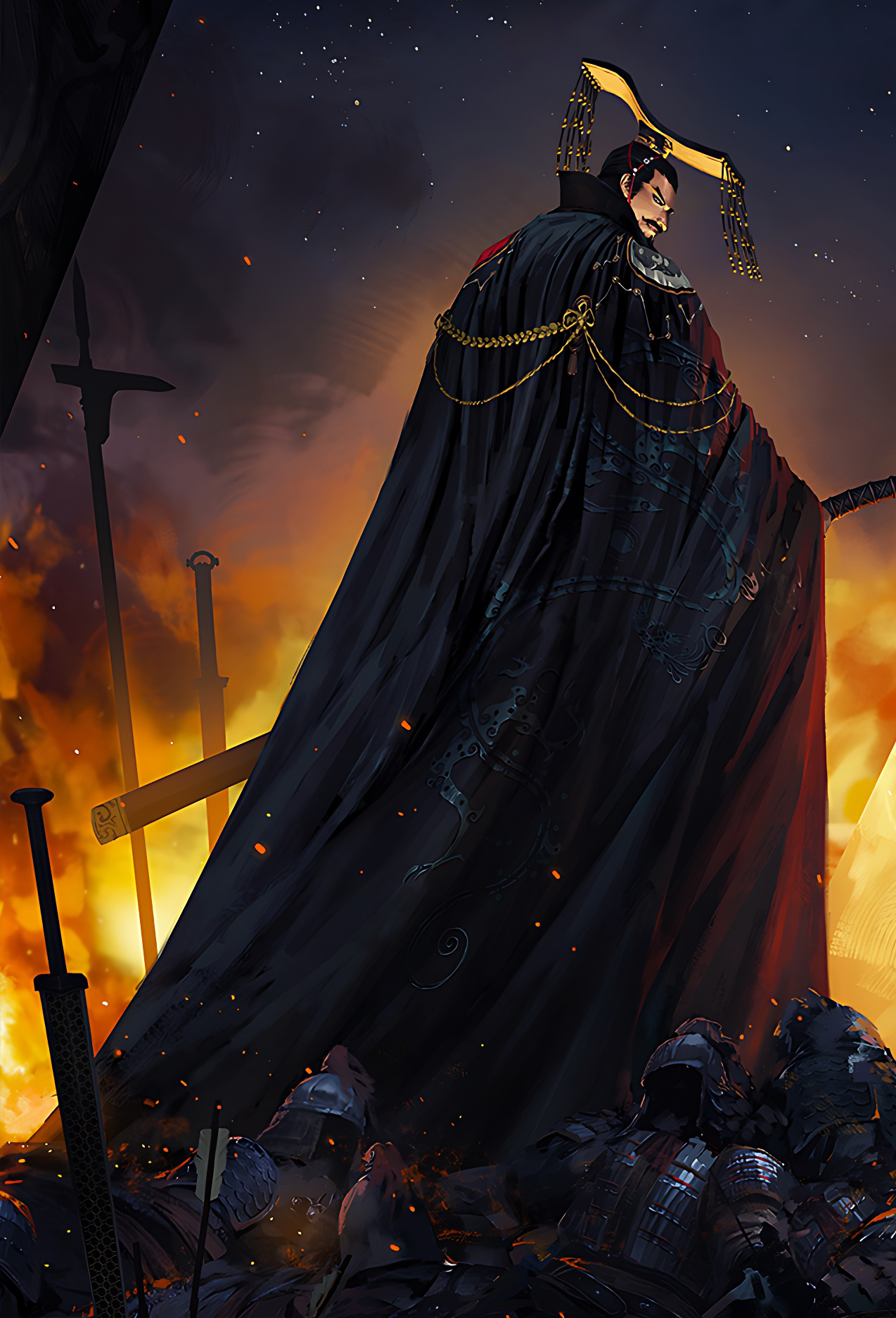
From top to bottom- prioritizing left to right. Topmost- Qin Shihuang (Shihuang is a title meaning "First Emperor") of Qin- Ying Zheng. Mid level left- Emperor Gaozu of Han- Liu Bang. Mid level right- Emperor Hongwu of Ming- Zhu Yuanzhang. Bottom left- Emperor Taizong of Tang- Li Shimin. Bottom right- Emperor Wu of Han- Liu Che.

Music: 无衣 (Without Uniform)
THE FIRST EMPEROR- QIN SHI HUANG
THE SPARE

The list began naturally with none other than the first officially styled emperor himself. The young King of Qin- Ying Zheng ascended the throne merely at the age of 13. Ying Zheng was born at an immensely important tipping point in Qin- and Warring State era's history. Through rapacious conquest and decade of warmongering (such as under the legendary general Bai Qi,) his formidable great- grandfather King Zhaoxiang turned Qin from a strong regional hegemon in the west to become the indisputable greatest military state of the realm.

.jpg)
Zhaoxiang's 57-year reign saw critical territorial expansions, including the brazen mask- off destruction of the Eastern Zhou court and breaking the backs of Chu and Zhao- 2 of the greatest peers against Qin supremacy in battle. However his later rule saw much of the early gains lost. Zhaoxiang's long life meant that when he passed- his son was only able to rule very briefly before he too passed due to old age. The vacant throne was then passed to Ying Zheng's father- a truly unexpected fringe candidate for the throne. Ying Zheng's father had been a hostage at Zhao (at the time Ying Zheng's father was merely a fringe son his own father- Ying Zheng's grandfather was hopelessly in love with his childless favorite wife.) It was at Zhao, that a ruthlessly ambitious merchant named Lu Buwei convinced the exiled prince with a ploy to become the sole heir to the kingom: by 1st become the adopted son of the favorite wife, then sire a promising son to secure his position in the chain of succesion. The ploy worked and Ying Zheng as born, engineered to take on the royal mantle, and when the throne briefly passed to Ying Zheng's father, he gratefully elevated Lu Buwei to become the Chancellor despite Lu's unseemly origins as a merchant.
%20LATE%20Q.png)
The early death of his father meant that much of the true reins of power was left to great regents like Lu Buwei and other ministers. And the tipping point rested on the question if the largely sheltered youth would take up the old rein of finishing up the unification effort or walk a different path.
Authorial insert- the realm was once under the sway of one royal dynasty already- that of the Zhou- and by this point the realm is largely a tripartite cluster- if not for Qin, then Zhao, or Chu- who each had spent centuries annexing their smaller neighboring states and harbored grand ruthless ambitions, these states also would not have any qualms about some level of unification. Modern history- especially recently with the likes of Extra History's recent very liberal take on the First Emperor missed the the name of the game of the period: that it was going to be an inevitable whirlpool of a Battle Royale toward unification and 1 survivor standing regardless between the eponymous "Warring States." Doubt my words? Just check out the many litanies of failed coalitions before this era which nearly all ended with backstab or one of the coalition's vaunted leaders abandoning others.
Music: Ode of the Qin

Ying Zheng grew up with a strange mix of personal obstacles and deep well justified insecurities because his position is largely an engineered creation of Lu Buwei who won the seat for his father. As such, young Ying Zheng's rein was well under the shadow of his Chancellor. His mother, the influential Queen Dowager Zhao's position at court was also owed entirely to Lu Buwei: thus both pillars: Lu and his mother- had little interest in the boy become too autonomous. After Ying Zheng became a man- a eunuch who serve his mother named Lao Ai attempted a coup against the young King's rule. The conspiracy was deeply scandalous- as it was uncovered that the Lao Ai- despite being a "eunuch" was in fact not castrated- and in fact had been a lover of his mother for decades- what's more they had behind the king's back produced 2 illegitimate children to replace him once he was killed. Nothing was it seemed and the poisoned barb was harbored and sanctioned by none other than his mother and her lover "eunuch." Ying Zheng reacted grimly, the dowager queen was imprisoned, Lao Ai and his 2 illegitimate siblings were executed, and Lu Buwei was removed from power- later he committed suicide in his exile. After internal consolidation, the Qin again turned its attention abroad,
THE UNIFICATION WAR

Born to (not) rule. Ironically the boy who would style himself the First Emperor along a Daoist sage king's stripes was once merely a spare. Conspired to be murdered by none other than his mother and her lover and replaced, Ying Zheng defied all odds and multiple assassination attempts to become a grim autocrat that finally overawed the rest of the 6 kingdoms.


Unlike the long drudging campaigns conducted by his great- grandfather which spanned and politicked across some 5+ decades, under the planning of Ying Zheng and capable generals like Wang Jian, Wang Ben and Meng Tian, this time the Qin overwhelmed the 6 remaining kingdoms in only 1 decade with multiple battles of annihilations and systemic follow-through. In a relatively rapid succession- the kingdoms of Han, Zhao, Wei and Chu all fell- and once Chu- the most powerful peer of Qin fell under a Qin invasion which composed over half a million soldiers for a prolonged campaign, Qin unification became inevitable. After a brazen Yan assassination attempt against Ying Zheng that came the closest to taking his life failed- Yan was also annexed, and at last, Qi, the only remaining state that largely placated Qin at every turn was left, when Qin marched into its land, Qi surrendered as well.

Finally Qin unified the realm under 1 throne. To ensure the stability and integration of the new realm, the Qin abolished the nobility of the other 6 states (Qin itself had long did so under the Legalist Shang Yang centuries before- turning the realm into a meritocratic state for both military and civilian officialdom) . Units and measurements, along with writing scripts and law was standardized across the realm under the minister Li Si. Unlike his predecessors, who bore only the title of Wang 王 which meant "King" Ying Zheng took up a newly consecrated title of "Emperor" or huangdi 皇帝 which had daoist connotations of ancient sagely deities.
Perhaps tellingly. Qin was said to have melted down swords and weapons from its foes and then forged them into great statues in the Qin capital.
Having unified the interior of China proper- the First Emperor then embarked on a grand series of engineering projects to secure the realm against external threats- inaugurating the linkage of the Great Walls under 1 unified spine and sending forays north and south. Though a legalist, the Inscriptions of Langya Stele 琅琊刻石- erected shortly after his completion of the unification wars was extolled Confucian outlook to peace, prosperity, harmony and propriety- as well as striving for the cosmic virtuous of the Daoist way.

"...Now, the Emperor has unified the whole country and made it into prefectures and counties. The world is at peace. He has made the ancestral temples bright, embodied the Way (Dao) and practiced virtue, and his title has been greatly honored. The ministers recite the Emperor's merits and virtues together and have them engraved on metal and stone as a record."
- Qin Inscriptions of Langya Stele

Unfortunate for Qin- (and fortunate to those who felt disempowered by it as well as its old rivals) Qin Shihuang did not live to truly old age- he died before reaching the age of 50 at 49 during a tour of the realm and his megalomaniacal empire- which saw nearly half a millennium of preparation by his patient ancestors- was undone in 1 decade after.
Music: The Mighty Wind Blows
THE OUTLAW EMPEROR- EMPROR GAOZU OF HAN- LIU BANG

Endlessly resourceful and full of cunning, the peasant born Liu Bang has the soul of a gambler and dealmaker. Charismatic, gregarious, and generous he was a vivacious contrast to many in his age. He would suffer many upsets yet the clever rebel always had the miraculous ability to bounce back to the playing field- whether via promises, bribes, or shameless persuasion that suited his needs. A self made hero capable of humane acts yet dangerous hand in equal measures.
Because Qin's succession was not ensured- chaos soon erupted in the wake of the First Emperor's passing. A powerful eunuch named Zhao Gao 赵高 soon seized power within the imperial court- the clique in power soon sought to preserve their stranglehold on court power by propping up a malleable son of the Emperor- Qin Er Shi (lit "Qin the 2nd") and they did so by framing the First Emperor's capable crown prince Fusu for treason then forcing him to commit suicide under falsified edicts.

Purges soon erupted within the highest echelon of the empire with Zhao Gao destroying many capable generals and ministers via lawfare and padding out the state with sycophants- a famous anecdote "Pointing to Deer and Calling it Horse" 指鹿为马 attributed to Zhao Gao's vile influence on the clueless 2nd Emperor had the eunuch regent present a deer to the emperor and call it a horse, and anyone who corrected this lie was later marked for death. Meanwhile- multiple pockets of the Qin realm exploded in popular revolt.

If Qin had lasted generations beyond after its founding unifier- it would have certainly been remembered to better lights- and likely something akin to that of Sargon of Akkad, Genghis Khan, -at least by their own people. However the imperial project was rapidly disintegrated in his passing. The rebels were a wide assortment of profiles: revanchist former nobles, popular peasant bands, former Qin officers, and many outlaws. Soon the Qin had multiple rebellions within its territories, though some were rapidly put down, others continued to erupt. Unlike the formation of the Zhou- which also saw a massive rebellion immediately after the death of its first short ruled- sovereign, ensuring centuries of primacy thereafter, the Qin (with the purge of many capable generals) was rapidly regionally consumed.

The man who would ultimately prevail against (and ironically uphold) the Qin was born to a peasant family. Liu Bang- born from the vanquished kingdom of Chu and grew up in the wake of Qin unification was once a lowly regional Qin sheriff assigned to escort many penal labors between Qin districts, when some of his prisoners escaped and he was marked for late arrival at his destination (an offense automatically punishable by death.) Instead of walking to his death- he decided to rebel with his freed prisoners. In time he soon joined several other rebellious bands against Qin rule- including Xiang Yu- a descendant of a high noble line of slain Chu generals also intent on toppling the Qin dynasty. Both served a new king of resurrected Chu and were sent on 2 prongs against the Qin domains. The Chu king promised both that whoever took the Qin capital would be greatly rewarded. In the east- Xiang Yu scored a miraculous lopsided victory at Julu- and utterly shattered a combined theater of Qin forces in the northeast- making him a dominant player among the coalition of desperate rebels.
2%20(3)%20(1).jpg)
But in the west- at the guarded pass of what was the old Qin heartlands, the more flexible Liu Bang arrived and promised peace and clemency to the Qin remnants. The new Qin emperor Ziying- who manage to ascend to power after purging other cliques inside the Qin court- saw the inevitable collapse of the Qin forces surrendered to Liu Bang and was offered clemency. However in Liu Bang's wake, Xiang Yu arrived- though flushed with victory, Xiang was livid at the sparing of the heartland of the kingdom that genocided his clan. Instead Xiang reneged on Liu Bang's promise and sacked the Qin capital, looted and burned down the Erpang Palace, burned the Qin imperial library (where many collected texts from the Spring and Autumn and Warring States that were confiscated were kept,) burned the Qin imperial tombs (ironically sealing the Terracotta Army under earth) and slaughtered many Qin officials, including executing Ziying. Despite the fact that the clever Liu Bang took the Qin capital first, Xiang Yu strong armed their patron's promise, and instead of allowing Liu to acquire the Qin heartlands, instead sidelined Liu Bang into a more periphery title, that of the fief of Han beside the Han river (from which the new state derived its name) and trapped between multiple generals loyal to Xiang Yu. Feeling his power secured as the 1st among equals of the victorious rebellion, Xiang Yu then brazenly killed their Chu King patron.
%20(4).jpg)
THE DUEL OF CHU- HAN CONTENTION

In the aftermath of that coup- Xiang Yu then proceeded to divide the overturned realm into Eighteen Kingdoms under the pretext of offering restoration of many vanquished kingdoms. It was a very short lived policy- as within the year this was outlined localized wars had already broke off between the newly consecrated regional kings. Thus did for a brief glimpse the restored world looked little different from the centuries of Warring State that it had just waded out of 2 decades ago. Liu Bang however- despite the initial attempt to box him in between Xiang Yu's loyalists, proved to be a capable player. He managed to consolidate enough of the former Chu king's loyalists and also much of the populace of the old Qin heartlands under his sway. The Guanzhong region (nestled mountainous region around the Qin capital at Chang'An- and for centuries hence would be known for the power of its military elites and peerless military tradition) would become a key loyalist region for Liu Bang due to his earlier clemency. Eventually, the fragmented 2nd iteration of warring kingdoms was reduced to only 2 major blocs, between that of the Liu Bang in the west and Xiang Yu in the east.

Although the likes of Lu Bu from Three Kingdoms era had largely been remembered as a peerless warrior in popular recollection- Xiang Yu was perhaps the closest ruler to the image of a peerless god of battle. Born from a long line of slain Chu lords that had served as its generals, Xiang Yu's entire career was distinguished by his band wading into suicidal odds and came out in victory. Yet despite his many strings of victories, he was outwitted by Liu Bang.
During their clashes Xiang Yu proved to be a vastly superior tactician and general, defeating multiple Han armies with lopsided victories, however, every time Han was beaten, Liu Bang still was able to pounce back with shocking resourcefulness. In time the desperate Liu Bang courted the capable general Han Xin- who held much of the north and was at the time seen as a vital Sword of Damocles that may descend on either the west or the east. Having secured his loyalty, Liu Bang then convinced Han Xin to fall upon Xiang Yu. Utterly politically outmaneuvered, Xiang Yu became trapped in the west- north pincer and was eventually cornered and slain along with his loyal band. Han supremacy was ensured.

.jpg)
Liu Bang's intention for the realm was a de facto compromise, despite having reunited the realm under his sway, he still continued under a pretense of autonomy for the various remaining powers. In that the kingdoms which had sided with him were allowed to exist as allied vassals- with them mostly existing in the eastern coast- while the Guanzhong region (the former Qin heartland) remained a bastion of Han control with enough imperial army directly under his authority to overwhelm the easter kingdoms should they get any ideas. Liu Bang's first attempt had most of such kingdoms either married into or slotted with members of the Liu clan- turning the ostensive disparate patchwork of potentially capricious vassal kingdoms all de facto into part of an imperial whole. Perhaps most tellingly of his intentions: Liu Bang built up a new grand palace not far away from the ruins of the former Qin one- and styled the new capital Chang'an- meaning the city of "Long Peace"/ "Eternal Peace."

.jpg)
At last after over 600 years of wars within the realm- internal peace was established truly in China proper. Liu Bang began to foster commerce within the realm with laisse- affaire Daoist influenced liberalism for merchants and also greatly reduced harsh sentences for lawbreakers, standard of living improved and stabilized under his rule. However- ever aware that his lineage was new and his grip on power largely momentary he still proved to be a deadly foe against challengers. Of the great meritorious generals that helped him won him the realm- Liu Bang soon began to fear them in the event that his position was weakened. Most famously he ordered the execution of the invincible general Han Xin which had elicited disapproval across the ages. Other senior ministers took the oppurtunity to retire, already afraid they may be next to incur the emperor's displeasure. Liu Bang's execution of Han Xin also came at probably the worst of times- for right after, the Xiongnu invaded from the north.
.jpg)
NEW CHALLENGES, NEW HEADWINDS
Fresh from the internal purge, Liu Bang raced off north with the Han army to confront the threat. The result was a disaster. Liu Bang was soon surrounded by the enemy and if it was not for a ploy that bribed the queen of the Xiongnu Chanyu (chieftain) Liu Bang would not have escaped from the trap. Humiliated- the Han sued for peace by offering tributes and marriage to the Chieftains. The policy of diplomatic marriages- Heqin (pronounced huh chin) had been variously debated- more conservative readings have read it as a position of weakness: the humiliating marriage to an would be equal/ superior- along with outflow of tributes.
.jpg)
.jpg)

Xiongnu: in old Chinese is actually pronounced "Hunnu" and the prevailing consensus among many historians is that the Xiongnu were the ancestors of the Huns.
More realist historians (including many of steppe descended states such as Mongols and Turkic writers) have remarked that Heqin in fact provided an insidious infiltration. That through this mechanism, the Han was able to both hijack the main royal line of the Chanyu but also raise the princes to culturally be inculcated with Chinese luxury and steered toward Chinese interests, thus overtime either remake or dismantle the regime from within.

One of the "Four Great Beauties" of Chinese history- Wang Zhaojun (frequently depicted in red fur lined robe and with an exquisite pipa) was a renowned beauty married off to the Chanyu.
Regardless of the interpretation, for the time being Liu Bang returned to Chang'an and focused largely on the internal affairs of the empire. To defend from the outside threats, the Han relied on the construction of its own Han Great Walls and cultivating a strong economy, stockpiling up a native reserve of strong war horses which took nearby a century, all the while Liu Bang and his successors slowly stripped the various vassal kings of their power. Han retained the Qin system of universal conscription for a period of time: most male commoners to serve in the military for two years- one year of training and one of active service, typically between the ages of 20 and 56. Meritocracy rather than old feudal distinctions of hereditary nobility was also retained- though with large degrees of laisse- affair hands off approach in economics. Punishment in general for various crimes were lessened, paving the way for unimagined level of internal peace and prosperity unseen in centuries, and prosper, Han most certainly did. After his death- Liu Bang was conferred the posthumous temple name of Gaozu- meaning "High Ancestor."

Ah the mighty wind blows, scattering the flying clouds,
After I unified the realm, I returned home.
How can I assign fierce warriors to guard the four corners of our nation.
After I unified the realm, I returned home.
How can I assign fierce warriors to guard the four corners of our nation.
- Liu Bang, "Song of the Mighty Wind"

After becoming the emperor- Liu Bang once returned to his home town and met with his childhood friends. There, they drank and celebrated for days- but once during a lull during the merriment he was supposed to have composed this poem, despite the sweetness of reuniting (with him almost like a mythical figure descended from nimbus and being the great wind,) he was filled with worries about how after unifying the realm and turned swords to plough shares- how to still guard the 4 corners of the nation on the new changing days ahead.
Music: 十五从军征 (Joined the Army at Fifteen)
Emerged from Wu's era and spoke of a soldier who
joined the army at fifteen and returned at eighty
THE WARRIOR EMPEROR- THE "MARTIAL" WU OF HAN

.jpg)
%20(1).jpg)
Invariably- the 2nd great Han dynasty Emperor of note- if not the greatest, was Emperor Wu of Han. Born Liu Che, a century after his ancestor's founding of the dynasty- Liu Che grew up in stability but he inherited an empire that was changing. Internally, for the past century his ancestors had slowly stripped away much of the regional power of the vassal kingdoms in the east- so much so that when afraid they would be all subjugated- they desperately rose up in concert during his father's rule in what was known as the Rebellion of the Seven States the conspiracy was poorly planned and poorly coordinated with various players failing to mobilize and arrive in time to reinforce each other, providing the perfect opportunity for the Han core in the west to utterly crush the rebels on the field then liberally strip away the kingdoms.
%20(1).jpg)
By the time Liu Che inherited the throne at a very young age of 15-16 in 141 BC, his father had left behind him an internally pacified, prosperous, realm. However his early reign was disgracefully sidelined. Instead of having the reins of power devolve into the hand of a young ruler- his powerful grandmother held sway in court, opting to continue much of the liberalized and tolerated corrupt blocs in court. Thus, unable to truly rule as he wished, the young Liu Che began to travel incognito in Chang'an and make friends and associates, in time building a band of talented followers whom he trusted. When his grandmother passed, the young sovereign made his move and positioned his parallel court into the various ministries completely under his authority. From this recentralization- Liu Che turned his attention outside of the realm.

An inexorable autocrat- Emperor Wu of Han (personal name Liu Che) was responsible for nearby half a century of war across various fronts in his remarkably long life. By the time of his death he had managed to turn the Han empire from a strong internally unified regional empire into the undisputable great power of East Asia- and set the foundation of the Silk Road. His posthumous moniker Wu 武 literally translates as "Martial" in remembrance
RENEWED OFFENSIVE AGAINST THE XIONGNU
For much of the last century- the frontier was plagued with Xiongnu raids. Where as the Qin had subdued and united many southern states in the previous century- the early Han saw them abandoned. With his ascension, Liu Che sought to finally confront the northern threat heads on- mobilizing the large wealth and war horses stockpiled by his ancestors. The initial attempt against the Xiongnu failed in farcical fashion, in an attempt to ambush the Xiongnu Chanyu (Chanyu means chieftain)- the alerted Chanyu and his army- who were entirely mounted on horse- easily slipped away from Han pursuit (Han despite having cavalry still relied on many chariots.) Despite the bloodlessness nature of this rather comical blunder, Han took the lesson to heart.

Battered: Early Han (Western Han) in yellow, the Qin- Han Great Wall in red, traditional invasion corridor used by Xiongnu forces to penetrate Han territory in green: By this time after generation of wrangling the interior of the Han had became for the most part a de facto unitary empire with imperial authority firmly consolidated under its autocrat.

Old Men: Li Guang was an wizened and veteran commander who had served several of Wu's predecessors. Dubbed the "Flying General" in his youth he had achieved a feared reputation among the Xiongnu on the frontiers. However he was both backwards in tactics as well as filled with immense pride to become a Marquis through climactic victory. Liu Che secretly did not trust the old warrior's adaptability and instead chose to rely on a caste of new men to lead his war machine.
Rather than relying on the remaining cumbersome chariots which were capable enough on flat open terrain but became inoperable in uneven terrain and required higher equipment cost- Han opted for full deployment of true cavalry- with the only chariots left largely composed of supply and armored war wagons. With the new war broken out- Liu Che also reformed the leadership of his generals. Instead of relying on many old generals- such as the like of Li Guang- Liu Che turned to his inner ranks. Elevating total political outsiders such as Wei Qing and his nephew Huo Qubing to lead his new armies.
Music: On the White Horse (by Cao Zhi)
Cao Zhi is the talented younger son of Cao Cao
An immensely talented poet but also tragically sidelined his entire life
he was famously attributed to have composed Quatrain of Seven Steps
White Horse is a favorite patriotic poem and dedicated to strips of
life long soldiers who gave everything for their nation
NEW MEN

New Men: to the shock of all, instead of relying on the old guard, Liu Che inserted total unproven unknown favorites into position of command- first Wei Qing and then Wei's nephew Huo Qubing. Both were total outsiders and descended as discarded illegitimate sons whose sole loyalty was to the young emperor. Despite the unorthodox nature of their untried nature, both managed to completely defy expectations with flying colors as great offensive commanders. Wei Qing scored an impressive series of victories against the Xiongnu Gobi Desert and Ordos Loop in what is today's Inner Mongolia.


%203%20(1).jpg)
Later Wei's nephew Huo Qubing proved to be an even more dynamic commander, and he was able to singe handedly inflict a string of victories in a lone contingent while completely behind enemy lines- then audaciously- proceeding on his own without nearby support swiftly captured the strategically vital Hexi Corridor in only 6 days. Together they also inflicted a decisive victory against the Xiongnu- with Wei Qing defeating the Chanyu's core army and the Chanyu himself at Mobei. With these series of victories, Xiongnu power was greatly weakened for a whole generation- and the Chanyu and his tribes were forced to retreat further north in the wilderness. From these campaigns Han secured both its northern and western frontiers for centuries.
.jpg)
%20(2).jpg)

Relentless: Wu's rapacious wars extended well beyond this rather dazzling initial period. Having greatly reformed the Han army and have it led by very capable offense- oriented cavalry commanders, the Han began to pursue a highly militaristic foreign policy- an unforeseen consequence of this was the return of a diplomat thought lost to the frontiers, Zhang Qian. Zhang Qian had been dispatched earlier as a diplomat seeking to act as Emperor Wu's ambassador in forming an anti- Xiongnu coalition with the various tribes out there who were also hostile to Xiongnu power. Despite having been taken under Xiongnu captivity, after decade of imprisonment he managed to escape and make back to the Han court.
.jpg)
%20(2)%20(1).jpg)
Han expansion during Emperor Wu's rule (original in orange- new acquisitions in blue.) These areas included but were not limited to most of what is considered southern China, including parts of northern Vietnam, the Hexi Corridor, the Tarim Basin, the Ferghana Valley, and northern Korea.

Iranic Peoples: Zhang Qian's western overtures were filled with disappointments. After spending years as a Xiongnu prisoner, Zhang finally escaped and made contact with other tribes he hoped would turn against the Xiongnu. However, they utterly rebuffed his suggestions for a Han alliance. Despite the failures of his initial mission, when he returned to Chang An Emperor Wu made great use of his western accounts and thereupon formulated his western policies.
Original Artwork by: Joan Francesc Oliveras Pallerols
During his return Zhang reported strange cities in the west- filled with strange people, and fruits that grew from vines (grape) and perhaps most alluringly- superb peerless Heavenly Horses that "shed blood." Intrigued- and with Zhang Qian's veracity proven by the growth of grapes in Chang'an, Emperor Wu dispatched fresh diplomats to secure these horses. After 2 campaigns in the Wars for the Heavenly Horses against Dayuan (lit. "Great Ionians")- supposedly made up of the Greek remnants of Alexander's conquest and former Greek exiles of the Achaemenid Empire, eventually the Heavenly Horses were secured by the westerners and given the Han a keen edge in shoring up its military power against the Xiongnu.

In the south, Liu Che pursued opportunistic meddling in various southern states, often by aligning with a smaller player and when wars erupts have the Han overwhelm the local defenders. Such campaigns would be followed by settlement of Han subjects in such territories. From these machinations, what would be today's southern China- from Yunnan to Guangzhou to Fujian in the east- even including what is today's northern Vietnam was incorporated into the Han realm.
%202%20(1).jpg)
Beside war- which was what he was primarily known for, Emperor Wu also embarked on a sweeping life long series of reforms which included but was not limited to: choosing Confucianism to be the favored state sponsored philosophy. The enshrining of Confucian primacy had a profound impact on the political, social and cultural fields of later generations of China in reverberation for the next 2 millennias. However, some historians credibly argued that he used Confucianism to cultivate virtuous folk customs and societal norm, while in reality using Legalism and legalistic rewards and punishments for the government. During his reign Emperor Wu also created a formal imperial academy: Taixue (lit "Supreme Academy" consisting of the highest learning institution within the nation. This institution was followed by the Bureau of Music. With Chang'an he aggrandized the palaces and even built the massive Kunming Pool- a man made lake large enough for naval training.

Emperor Wu toured extensively across the realm in his entire career- in both assessing local conditions and also rendering ceremonies and rituals to the cosmos. For example, in 110 BC he personally led 180,000 cavalry, their banners stretching for miles, to perform the Fengshan ceremony at Mount Tai, then toured the eastern coast, and finally reached Mount Jieshi.
LATE REIGN: INTERNAL INSTABILITY & AVERTED CRISIS

In the 110s BC- Han experienced a severe series of famines, in 115 BC heavy rains and snow struck Guandong ; a major flood followed in the summer. Thousands of local people starved to death. In April of 114 BC, severe hailstorms struck many areas, causing a major famine in more than a dozen counties in Guandong. Crops failed completely, and cannibalism occurred. Wu gave sanction for the populace to move to neighboring territories and also distributed grain from Sichuan to the affected regions. In the summer of 107 BC, another severe drought struck, causing the land to crack, rivers to dry up, and many people to die of thirst. Two million refugees appeared in the heartlands, including 400,000 unregistered farmers. In the autumn of 105 BC, another severe drought and locust plague struck, with locusts devouring all the crops. Wu responded to such crisis with reallocation of grain, and the sweeping establishment of a series of canals, reservoirs to ease in agricultural production and transport for the general peasantry. These are but but a glimpse of the many crises that both occurred during Wu's reign and also redressed- it should also be noted these occurred often simultaneously within his military campaigns as well.

In 99 BC, the rebel Xu Bo from Langya area (Anhui) launched a peasant uprising. They occupied the mountains and constructed strongholds, attacked nearby cities and towns, seized weapons, released prisoners, captured prefects and commanders alive, and killed and plundered high-ranking officials. In addition, other rebels such as Mei Mian and Bai Zheng in Nanyang , Duan Zhong and Du Shao in Chu , and Jian Lu and Fan Zhu in Yan and Zhao also launched peasant uprisings. For a time the belly of the empire was riddled with such rebellions. Wu first sent small detachment troops to suppress them, and then sent a large army to pursue and annihilate them, killing tens of thousands of rebels in total

By his late 60s in the 90s BC- Wu was beginning to be more isolated and cruelly purged officials he did not trust. As a result he was ringed by unreliable ministers who above all fed his innate paranoia- supplying leads whenever Wu had suspicions. After instigating the purge and execution of several innocent officials framed for witchcraft against the emperor, several of whom framed the crown prince Ju with the lies he was motioning against Wu. Though Wu did not initially believe these lies- Wu's son- fearful that his father had been turned by the lying ministers rebelled. The 2 sides battled in Chang'an's streets for 5 days but when it became apparent that he had lost the rebellion prince Ju fled and then committed suicide. His mother- once Emperor Wu's favorite was also forced to commit suicide as well. With consistency, the greatly saddened emperor was still forced to reward his son's slayers. The witchcraft purges continued for a time until once of the forthright ministers convinced Wu (who was already suspecting an incomplete picture) that his whisperers were liars. Wu then conducted his own independent research and thereafter slew the lying whisperers- burning one and slaying the other's entire clan. He then promoted the upright minister to be Chancellor.
%20(2).jpg)
A DIFFERENT FUTURE
In 88 BC Wu fell seriously sick, and without a designated heir and tax burden heavy Wu listened to the suggestion of the new Chancellor- what he did was quite unexpected. Wu publicly issued an edict where he apologized for his mistake, his rapacious wars, the heavy tax burden on the populace, and promised and end to the expansionary wars, reduction of corvee, focus on agriculture and prosperity, and for having listened to the advice of bad ministers. Many of these policies were long advocated by the late Prince Ju and these were realized after his death. At the age of 68 and with failing health, Wu was very grimly aware of the problem facing his death- his surviving older sons are hypocrites and are aloof of obeying the law, instead he chose to pass the throne to his youngest son, who was only 6 year old at the time- to ensure the smoothness of the transition- he entrusted the supreme power of the state under the guidance his trusted minister Huo Guang (the half- brother of the now long deceased Huo Qubing) and a well- trusted Xiongnu prince- turned personal favorite of Wu named Jin Midi (the ancestor of the great Eastern Han general Bang Chao.) With the powers well invested under their care and all parties pledging loyalties to uphold his heir, Wu died soon after several days later.

- Edict of Luntai
A HAN POST SCRIPT AFTER THE WARRIOR EMPEROR

%203%20(1).jpg)
Images: Digitally reconstructed multi story of Eastern Han mansions. Based on various
painted funerary models of such buildings- representing a significant element of verticality in the urban landscape of this era in China.


Despite the burdens emplaced by the Warrior Emperor- his final acts was well placed. Huo Guang and Jin Midi both turned out to be astute and faithful ministers and shepherded the young Emperor into a stable era. By contrast to the exhaustive expansionary wars- and severity of Wu's reign- his successor emperor Zhao and Xuan (in fact a son of the late slain Prince Ju)'s rule were known for their peace and immense economic prosperity, culminating in the great enrichment of the general Han populace in the following century. By the time China reached 0 AD Chang'an and Luoyang stood as 2 immensely rich urban centers. A census in 2 AD recorded nearly 60 million people in the empire, representing about one-fourth of the world's total population. With the cessation from prolonged war, nearly 100 years of stability and internal consolidation followed.


%20(1).jpg)
After the eras of Emperors Zhao and Xuan, the Han entered into a momentary lapse into courtly corruption and nepotism- dominated by powerful ministerial clans and palace intrigue. During which an ambitious and reform- minded minister named Wang Mang managed to overthrow the imperial Liu clan from within and briefly establish his own Xin 新 meaning "new" dynasty in 9 AD. For a time he ruled as a new emperor while keeping many of the surviving Liu princes under watch. He also drafted many strict yet high minded reforms with hopes it may alleviate the general populace. Unfortunately for his intentions his reforms were carried out badly and within a decade rebellions erupted virtually across the whole expanse of his empire.

Music: Quatrain of the Seven Steps (Cao Zhi)

One faction that managed to gain ascendancy during this chaotic interlude was from a minor branch of the Liu imperial clan descended from demoted Han regional vassal kings- and through an arduous decade of war and politicking as well as immense heroism: Liu Xiu- who rose from a farmer to become a rebel, and from a rebel to a warlord general, and finally from a warlord to the emperor of the new Eastern Han- by this time Luoyang became his capital and he ruled from there as the new Guangwu- lit. "Shining Martial" Emperor. His restoration of the realm from the abyss of total chaos to stability was such that the realm entered into a new golden age right after. Thus did the Han enter from the golden age of 1st century BC right into the golden age of 1st century AD.


Eastern Han shortly after the death of Emperor Guangwu the "Shining Martial Emperor.” By the time of his death the empire re-entered a new golden age. The talented and much beloved emperor gave his dynasty another 200 year lease in its lifespan.
TO BE CONTINUED IN PART 2-
WHICH WILL COVER EARLY MEDIEVAL AND
HIGH MEDIEVAL CHINA
STAY, TUNED


➢ ☯ Futsunomitama
➢ ☯ MK Celahir
➢ ☯ Muramasa
➢ ☯ Thomas Vieira
➢ ☯ BurenErdene Altankhuyag
➢ ☯ Stephen D Rynerson
➢ ☯ Peter Hellman
➢ ☯ SunB


Comments