Qin Military (Warring States Era) Overview: 战国末期秦军概况


This is the excerpt of a far longer article that is wholly dedicated to the society, strong players, and organization and lifestyle of the late Warring States period. This chapter will be entirely dedicated to the formidable kingdom of Qin in this era. Please enjoy the wealth of reference provided. -D
Reenactor: 张宇莹-小花
Reenactors: 洪玮 Hong Wei (Formerly 柿子菌)
-.jpg)

%20LATE%20Q.png)
End Game | Late Warring States period: Qin and Chu's territories vastly outstrips the rest of the kingdoms. While smaller in size- the relatively new dynamic kingdom of Zhao (having reached its critical mass only half a century before this era) still remain a dangerous match to Qin. However Zhao's meteoric gains came with its own baggage- Zhao frequently annexed territories from the nearby states of Wei and Qi, thus incurring little good will from other nearby weaker states. Ironically despite the undoing of its earlier ambition to completely vanquish Qi, Yan became a great hegemon for a time in the northeast, however it soon also lost its gains to Zhao. Thus by the final days of this age, Yan and Qi became pale shadows of their former selves, having bled each other white and languishing in their reduced status.
JUGGERNAUT OF THE WEST
.jpg)
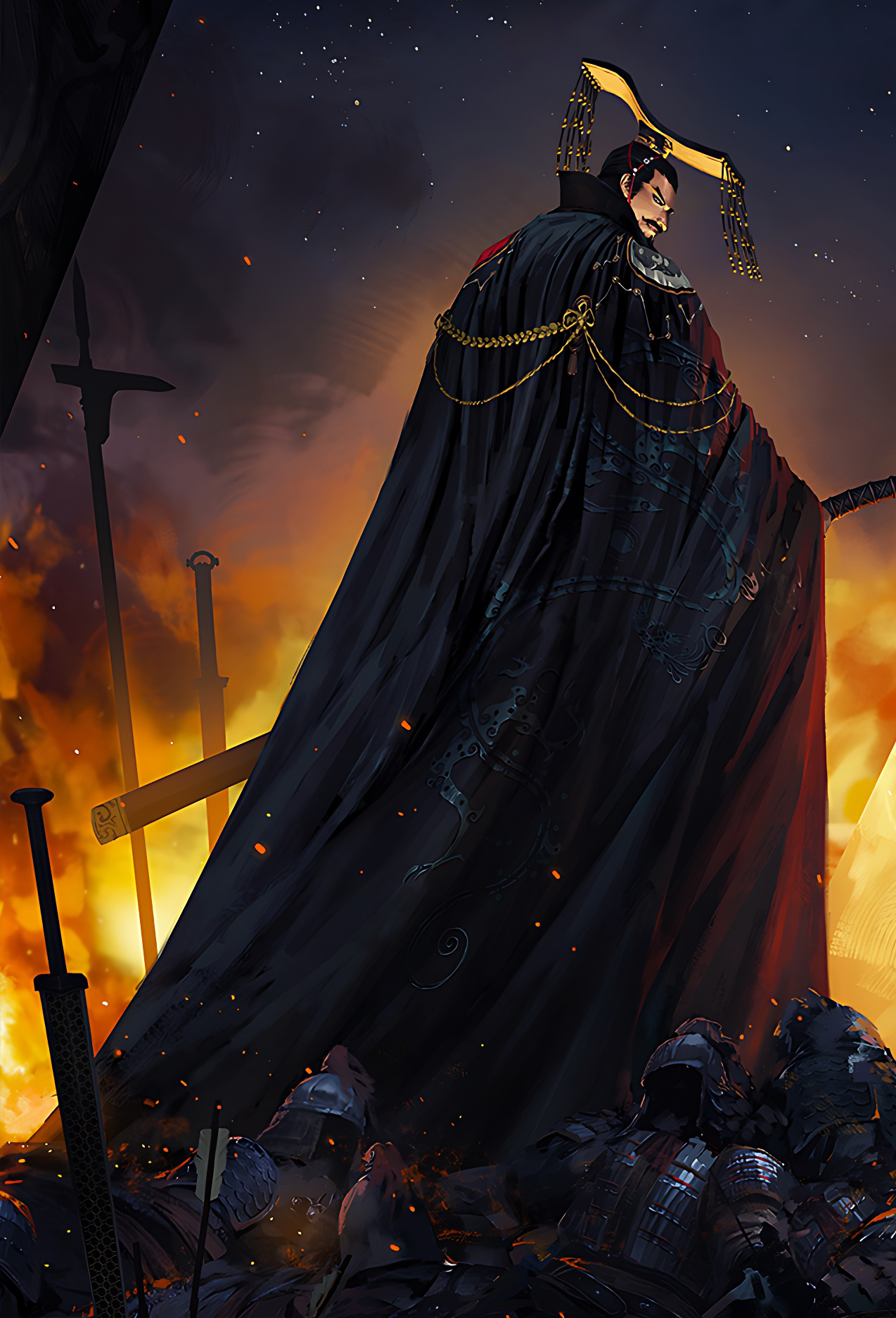
The late Warring States period is bookended by 2 dynamic and megalomaniacal autocrats both from the western kingdom of Qin. Many readers may be already familiar with the First Emperor Qin Shihuang (personal name Ying Zheng) - however it was his grand- grandfather King Zhaoxiang who unleashed the 1st major attempt to shatter Qin's enemies in a realm wide warpath. King Zhaoxiang's 5 decade reign was one of the longest his age as well as in Chinese history and it was during his reign Qin legions first broke the back of many of its most dangerous enemies on the bloody field.
Music: 无衣 (Without Uniform- Qin War Poem)


Qin at the onset of the late Warring States period: Qin's final victory (and mastery over the fate of China) was not an accident but a wisely charted path. It began the Warring States in grim humiliation- being crushed by Wei and languishing as a broken power in remission during the early period. However by the middle period it drastically altered the trajectory of its fate. 135 years before the First Emperor-, through the ruthless adoption of Shang Yang's Legalist reforms across its entire society- Qin abolished its old nobility, and made all ranks of military and civilian sectors a complete meritocracy that is only allotted to those who had proven their worth. The land was redistributed to industrious farmers and merchants reined so their profits must align with state's interests.

.jpg)
.jpg)
Shang Yang's statist aims did in the end create the most powerful army of his age- under Shang Yang's personal leadership in battle was able to revenge upon the state of Wei for its past transgressions. After Shang Yang's death- the kingdom was able to continue to play its cards very well in the high stake game of diplomacy between the kingdoms. When a joint 5 kingdom invasion- in one of the age's 1st great coalition war tried to breach into Qin- Qin was able to miraculously defeat them at Hangu Pass. Shortly after it was able to stabilize its position by cleverly play off its eastern enemies- often by aligning with the state of Qi in the east to keep the weaker center states separated and ripe to be exploited.

It was even able to manage to backstab Chu critically in this era by reneging promises and breaking treaties just to lure it into slaughter. By the time of young King Zhaoxiang's ascension- Qin was both experienced in battle and well secure in its position. However it was still a regional power. It was in this context that he discarded the facade of being one of many powers and made the bid for unification war against most of the remaining kingdoms. From this point on let us examine the Qin war machine in closer tactile detail.

Reenactors: 洪玮 Hong Wei (Formerly 柿子菌)
Qin Vanguards: the best of the Qin army are well armored and well disciplined: with a quote by Xunzi, the 3rd great Confucian scholar who lived in the tail end of the age that Wei Wuzu "Wei Martial Troops" is greater than Qi Jiji "Qi Assault Warriors," however Qin Ruishi 秦锐士 (lit "Qin elites") are better than all. Reconstructed Qin Ruishi armor is based on helmets and armors excavated from Pit K9801 in the First Emperor's Mausoleum in Xian.

The square pieces of lamellar are made of lacquered hide and connected by silk cords- a tradition that is not out of vogue with armors of the previous era. Note: the difference of course is the greater proliferation of armor worn by the rank and file soldiery. Where as armor were once almost exclusively worn by nobles and lower nobles and charioteers in the Spring and Autumn period by the Warring States period all of the remaining states have massively expanded their armories and capacity for armor production.

Armory: Cold Light Armor (寒光甲胄工作室) Reconstructed Warring State/ Qin era Ji halberd. The bronze blade is fastened to the lacquered wooden haft- because the spear point is not connected with the blade there could be considerable distance between the blade and the spear tip. This configuration allowed for massive production of scale in vast numbers.


Reconstructed Qin Ruishi armor is based on stone plated helmets and armors excavated from Pit K9801 in the First Emperor's Mausoleum in Xian.


Armory: Cold Light Armor (寒光甲胄工作室)
Music: The Heart of Qin


Various Qin Terracotta Army armor types. Different modular configurations also exists for crossbowmen, archers, and cavalry, as well as charioteers- who are often provided extra armguards against enemy slashing attacks.

By the late Warring State's era both Qin and Chu had vast legions of armored crossbowmen.
It became a highly favored weapon by all the greatest kingdoms of this age.

.png)
Armored warriors would have been deployed in a variety of roles: by the late Warring States period- not only are the soldiers well familiar with the personal polearms of Ji (bladed halberd) or Ge (dagger axe) and Pi (broad spears) but also have extended versions of these weapons that practically acted as slashing pikes.
.jpg)
.png)
Closeup of the armguard of Qin armor: such armors are frequently seen depicted on charioteers from excavated examples in the Terracotta Army.
.png)
.png)
Note: Though iron made weapons had began to be more proliferated in 3rd century BC China, the era's armies are still equipped with some bronze weapons, thus treated and lacquered hide plates would provide a surprisingly resistant as well as flexible suit against such weapons (even in recent centuries lacquered leather special Yi people's red lacquered hide armor can protect well even against steel weapons) or provides ample protection from bronze tipped arrows. Then silk cords- which even in later millenniums could comfortably resist even steel arrows and steel cold weapons are well protected from potential danger of bronze ji (halberds) / and ge (dagger axes) parting the linkage.
CHARIOTS OF THE LATE WARRING STATAES PERIOD


.jpg "Late Spring and Autumn era chariots, by this time both the horses and the riders were almost always heavily armored, with thick lacquered hide armors protecting the horse's front and sides heavy armor protecting the riders.")
Though late Warring States period marked the true proliferation of true cavalry in Chinese warfare- used to expertise by the state of Zhao- Chariots still remained in use in the twilight of this age well on to the following Qin dynasty and the early Han dynasty. By the Warring States period- specially dedicated war chariots led by 4 horses (quadrigas) had became heavier than the Spring and Autumn era counterparts- and excavated examples of chariots had showed bardings of lacquered hide for horses and good armor for riders. The rider would be centrally positioned (often with protected armored sleeves) and to his right would be positioned a lancer, and to his left a dedicated archer or crossbowman.

%202.jpg)
In previous eras- chariot borne aristocrats dominated warfare of Spring and Autumn era whereby combat was largely fought between well equipped but small number of elite chariots- that were quickly followed by relatively small group of foot guards that are attached to the chariots. However by the Warring States period- warfare became one of grinding affair and total war between large infantry blocks and crossbowmen formations. Infantry became an independent branch of the military, replacing chariots as the dominant force.

Chariots, infantry, and cavalry gradually became separately organized according to their respective branches. The 4th highest noble title in Qin is 驷车庶长 "Master of Quadrigas", and is in charge of the array of quadrigas.
Music: The Grand Ceremony of Qin
THE QIN ARMY- AN OVERVIEW
-.jpg "Shang Yang's final set of laws were entirely directed as strengthening the state. After the dreadful punishment of the crown prince's tutors, the rest of the Qin state became obedient to his rule and for 10 years no major incident occurred to challenge Shang Yang's power. During this decade, the disenfranchisement of noble titles now extended to their landed properties, and it was during these years that Shang Yang seized their properties and reassigned them to ambitious farmers and ambitious soldiers who excelled. On a broader level, the stripped fiefs were divided into counties and commanderies, and they were to be governed by appointed (and tested) officials made and unmade at the Duke's leisure. Large families are broken into smaller units where by sons are all encouraged to move out and farm their own atomized plots. Furthermore, Shang Yang's collective policies were adopted in the Qin military.")

Shang Yang- Lord Shang. A willful foreign scholar born from the small state of Wey 卫 (not to be confused with the central state of Wei) - Shang Yang arrived in the wake of Qin's humiliating crushing at the hand of his own state of Wei. Realizing that his own state was in critical need of reforms- the humble yet ambitious Duke Xiao put out a call for all talents that would come and reshape his languishing realm. After meeting the Duke Shang introduced his preference for Legalism~ heavily based from the successful framework created by the Wei Chancellor Li Kui a generation prior, with the aim of creating a 富国强兵 "rich nation and strong army"

Xiao became deeply fascinated. Xiao was so engrossed by the proposal listed by Shang that the 2 then talked for some 3 days and nights straight without tiring about implementing various reforms and laws needed to realize them. At last, Xiao was duly convinced of the value of Legalism and elevated Shang Yang to the position of the Duke's chief advisor. Their partnership would last 2 decades, during this time Qin was reformed painfully from top to bottom. From these policies- the traditional Qin nobility was abolished and its people and army organized collectively- in its wake a grim efficient martial state was born.
COHESION AND REORGANIZATION
NEW MILITARY ORGANIZATION


In matters of organization Qin placed special importance to divisions of 10, but further prefer to subdivide into 2 halves of 5. According to the Qin infantry military system by the late Warring States period: "Five men form a squad called wu (伍) -"five", with one squad leader; two squads 二伍 (10) form a shi (什) -"ten", with one shi leader; 五什 (50) form a tun (屯), with one tun leader; two tun 二屯 (100) form a bai (百) -lit "hundred", with one bai general: jiang (将) ; then with a bai commander (五百主) -lit "master of five hundred" in charging five hundred men; and a commander in charge of one thousand (ie 2 bai: 二五百主). lit- "master of 2 five hundred."

The cavalry was organized along these lines: "Four riders form a zu (组) -group, three groups form a lie (列) -column, and nine columns of 108 riders (骑) form a dui (队) -squad." The chariot soldiers were: "Eight chariots form a flank/ row called Pian (偏), two flanks form a zu (组) -group ^ same as cavalry, and four groups of 108 banners form a dui (队) -squad."
NEW RANKS OF SERVICE- BASED NOBILITY


The highest 3 ranks are: dashuzhang 大庶长 or "Master of a Great Host," the second highest being guanneihou 关内侯 or "Marquis Within the Passes (around the capital)," and the highest being chehou 彻侯 or "All-Encompassing Marquis." The ranks conferred their bearers certain privileges and a semblance of the lands formerly presided over by the aristocracy, but only the highest of them can be seen as titles of nobility.
.jpg "Now, all Qin military officers are promoted according to performance, from lower level officers to great generals, all the way to Qin princes. If they failed to fulfil their duties, they would be stripped of their current rank, if they lead their respective army into great calamity, they would be executed or severely punished and have their lands and titles stripped. Furthermore, 5 Qin soldiers are organized into 1 small unit, punishments for transgressions are meted out to his all of his unit. Deserters are collectively punished. If one deserted without being stopped by his comrades, the whole unit will be executed. But if he is caught and slain, his capturer will be rewarded.")

Armored Qin crossbow soldiers at the time of the First Emperor-
after the Qin reunification of the realms.
Reenactor: 张宇莹-小花
Reenactors: 洪玮 Hong Wei (Formerly 柿子菌)
The Qin heartland was not particularly fertile, and had arisen in what is today's semi- arid Shaanxi Province. Though the region had been a well entrenched position since the time of late Shang and the founding of Zhou (where the Western Zhou held court from this ancestral fief) when the Rong barbarians sacked the capital- plunging the Zhou realm into the Spring and Autumn period of high warlordom, before the royal court departed for the new capital in the east in Luoyang (inaugurating what would become Eastern Zhou) the fallen territories in the west lost to the Rong invaders was promised to the Dukes of Qin IF they were able to reconquer it.


Over the centuries- and with the notable death of several Qin dukes fallen in battle in their long Reconquista, the west was again secured. It was from this position as the shield of the realm in the west, the first contact point of all manners of barbarian invaders from the west from the Hexi Corridor that the Qin became one of the most formidable military states. Despite these proven advantages- before Shang Yang implemented his drastic top down societal reforms- Qin was still led by a largely aristocratic elite that lorded over a frontier military farmer population. However this greatly changed afterwards.

With the abolishment of the old nobility and top down mandate that all military officers and soldiery must be promoted based on merit (based on the heads taken in battle,) the Qin became a martial state that boasted both formidable elites as well as massed and well drilled specialized deep arrays. By the late Warring States period the Qin army deployed formations of specialized crossbowmen, archers, infantry, cavalry, and chariotry. Like all armies of this period which still primarily relied on infantry blocks- the Qin was no exception, albeit with the front of the ranks filled with crossbowmen.


Closeup of Qin armor- a feature that many Qin and later Han armor demonstrated is that armors are made with a cuirass that can be worn like an article of clothing and with already- build in pauldrons (shoulder pads) that are sewn to the sides of the torso armor and can be unfasted with a knot in the right shoulder (East Asian cultures strictly prioritizes the right hand and given this preference would also make this flank the one that is not prominently facing the enemy.)
EQUIPMENT AND INDUSTRY

This arrangement provided extreme ease of use at dangerous times the ability for unarmored soldiers (such as those resting in their quarters at night at camp) to swiftly put on their armor in an instant. Qin manufacturing of arms and armor are also well standardized by the time of Qin Shihuang's influential Chancellor Lü Buwei according to uniform measurements and equipments such as crossbow bolts are interchangeable despite producers.

Even 135 years before Qin overwhelmed all of the rest of the kingdoms: Shang Yang had declared that there are only two important factors in the life of a state (of his age): farming and fighting: more specifically with the ideal of 富国强兵 "Rich State, Strong Army." Only a strong agriculture can support an ever-expanding war. "The Records of the Grand Historian" later commented that the strategy of farming and fighting ultimately enabled the Qin state to unify the world.
Music: 赳赳老秦 (Mighty Old Qin)
STANDARDIZATION AND SPECIALIZATION
.jpg)
Lighter and heavier components. Lightly armored Qin crossbowmen with an armored comrade wielding a hand dagger axe. During Qin's unification war, the army had almost 1,000,000 soldiers when combining garrison troops, conscripts, militias and allied/annexed forces. By conservative estimates modern historians assesses that Qin’s permanent, regularly maintained forces numbered roughly 200,000–500,000 soldiers.

Qin sent 600,000 strong army to defeat Chu, it should also be noted at various times the Qin also conducted simultaneous operations against other smaller kingdoms or stationed garrisons along the northern Great Walls. The following infographics are from 洪玮 Hong Wei (Formerly 柿子菌) and can be found on his Twitter page- please go support his great work!


.jpg)
Standardization not only applied to punishments- but are also conversely applied to rewards as well: During a 1970s excavation an in tact tomb of the era still preserved bamboo slips that clearly stipulated various provisions of the Qin soldiers which since then had remained illusive to historians. The slips contained provisions such as: soldiers were forbidden from fraudulently claiming military rations, violators would be exiled to the border for two years; soldiers who privately bought or sold military rations would also be punished. The law also stipulated that officers received different treatment in terms of food than soldiers- pointing out that within the Qin army, rations were standardized according to ranks and provided by the state.
.jpg)
.jpg)
.jpg)
.jpg)
.jpg)
.jpg)
.jpg)
.jpg)
For major campaigns (final unification wars, later frontier drives), Qin could mobilize substantially more, commonly cited aggregate mobilizations of 600,000–1,000,000 or more.
.jpg)
Given the frequent necessity to conduct extensive multi- year campaigns beyond the vicissitude of seasons, the Qin logistic arms were well standardized as well. Historical records indicate that a soldier's monthly ration was approximately 40 jin (20 catties). After Qin acquired the Ba-Shu regions, its military grain reserves became significantly higher- allowing for a secured southwestern front and well stockpiled granaries for extensive campaigns against other Zhou kingdoms. Long campaigns, such as those deployed in the fatal duel with Chu in the high point of the unification wars during Qin Shihuang's time accounted for nearby half million tons of grain for such campaigns.
%202.jpg)
.jpg)
Music: The Power of Qin
BLOODY INCENTIVES

Because of the bloody incentives of promotion based on taking of enemy heads- at times such demonstrations could be brutal on an geometrical scale. In the lopsided battle during the middle Warring States period where 5 kingdoms attacked Qin in a joint coalition, Qin not only resisted their invasion at the Hangu Pass but in the counter attack Qin utterly eviscerated the coalition and slew then decapitated over 80,000 enemy, including much of the coalition's commanders.
.jpg)


Although head taking in particular is not unique to Qin- previous ages the victors of various Zhou states built 京观 Jingguan- which during the Spring and Autumn period was a grim monument of victory. A Jingguan was a pyramid of skulls- made from the severed heads of defeated enemies, and mortared together so that the bones and the earthwork eventually marks the site of battle and commemorate the battle for the victors, the Qin proved exceptional in their string of victories under the life of career generals such as Bai Qi.

King Zhaoxiang's Butcher of Legions: Bai Qi- despite multiple decades of grim military service- personally responsible for breaking both Chu and Zhao's limb in battle, and According to the Record of the Grand historian, he seized more than 73 cities from the other six hostile states with accounts of total military deaths inflicted over a million, and to date no record has been found to show that he suffered a single defeat throughout his long military career.

PLEASE STAY TUNED FOR THE FULL ARTICLE- WHICH WILL COVER THE NOBILITY OF THE OTHER KINGDOMS, AND A SNAPSHOT OF THE WARRING STATES IN ITS RUTHLESS FINAL HOURS.


➢ ☯ Futsunomitama
➢ ☯ MK Celahir
➢ ☯ Muramasa
➢ ☯ Thomas Vieira
➢ ☯ BurenErdene Altankhuyag
➢ ☯ Stephen D Rynerson
➢ ☯ Peter Hellman
➢ ☯ SunB


Comments
1. Thanks for going over the unit designations of the Qin, it seems the decimal system is common in Asia, from the the ancient Chinese to the Steppe horse archers and even the ancient Achaemenid Persians. But what about the higher units, what was the largest unit, was it like the Mongol tumen, units of 10,000 commanded by a high ranking court official, were these commands permanent units like the Roman Legions and named after their locales?
2. And I'm curious about this innovation by Shang Yang, the 20 Rank Order of Merit system. Did it overlap with military unit ranks? Can a lowly Decurion or Centurion get promoted to the highest Tier of Rank 20 by collecting 20 heads?
3. This head hunting tradition is very curious. I'm sure it was true, the Samurai of Japan are famous for it as well. But how did this 'head hunting' actually proceed on the battlefield, was it after the victory or during the battle? As far as I know, the ancient Greeks and Romans never practiced this head hunting thing, curious if this actually worked in motivating the troops. And this Skull Tower tradition seems to be an ancient Asian thing, culminating with Timur the Lame who was famous for his Skull Towers from Moscow to Delhi.
4. To what extend did a sense of 'patriotism' or even 'nationalism' exist in the Warring States Period. Did everyone from the King down to the lowly trooper and his family have a sense of love and devotion for the Qin State? To march to far off lands, suffering hardships, being constantly disciplined by officers and generals, being away from home, wearing heavy armor, and fighting and killing the enemy and potentially dying on the battlefield or by disease, the ancient Warring States solider must have been greatly motivated, were the 20 Rank Merits enough do you think?