Armored Masks in Chinese Warfare: 面甲


Above: Rare Song Dynasty bronze face guard excavated in Shandong, China. Middle: Ming Dynasty "Full Iron Armor" Reconstruction According to Image & Manual
Art by: by: 蒸魚葱
The use of protective metal face masks in Chinese warfare, while never as widespread as in other armor traditions, represents a recurring theme of elite protection and psychological impact. Textual evidence for their use dates as far back as the Warring States period (475-221 BC), where the soldiers of the state of Han were recorded as wearing iron facemasks. However archeological evidence suggests earlier- and as early as the Shang dynasty.
Music: Ballad of the Sun Crow
ANCIENT EXAMPLES

Above: Ceremonial Shang mask- heavy and has double sided sculptural dimensions. Below: utilitarian masks, with nose slits and actually practical slits for binding straps.

Shang Dynasty bronze mask did exist, but it’s uncertain how widespread it is, if it was worn in battle or only worn for ritualistic rites. They are not funeral because they have breathing holes and also openings for binding straps. The Shang practiced vigorous warfare in most of its history with external focus and expansions in the early and late period and significant civil wars in the middle phase of its lifecycle.

A hypothetical reconstruction of a Shang dynasty warrior. He carries a long ge dagger axe which can be used with 2 hands (there's argument that ge for shielded warriors are actually 1 handed.) He carries a large leather reinforced wicker shield. He wears a one-piece lacquered leather breastplate. He wears an elaborate bronze helmet with animal motif. He wears a bronze mask secured via a strap and protected with a flap. The quality of the breastplate varies depends on the animal since during the Shang, aside from oxen, rhinos and elephants both roamed the Yellow River basin. He wears a bronze helmet furnished with elaborate animal motifs designs. Such warriors would likely have served well as elite guards and noble infantry or in capacity as chariot- borne archers and lancers.


Middle: early Chinese shields, Shang and early Zhou shields are wicker frames covered by decorated leather. Some of the earliest pictographs and letters featuring warriors and shields displayed shields with a prominent central spine that extended well above and under the main body of the shield.


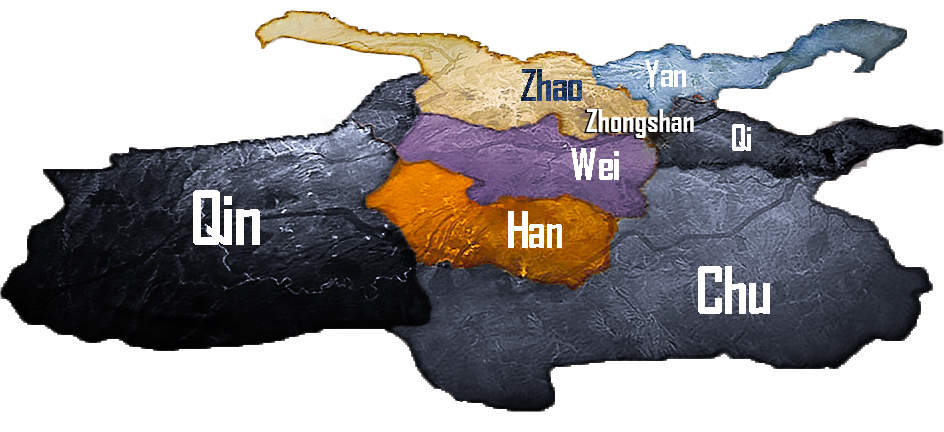
By the onset of Classical Antiquity China definitive records of armored masks were recorded in the "Strategies of the Warring States" 战国策, speaking of the minor regional kingdom of Han 韩 - (not to be confused with the later Han dynasty which has a completely different character.) Though Han stood as one of the weakest of the 7 major "Heroes" of the competing kingdoms, its qualitative edge and equipment for its elite shock troop was still well- praised.
“The swords and halberds of Han's soldiers are all forged from the renowned ironworks of Mingshan, Tangxi, Moyang, Hebo, Dengshi, Wanfeng, Longyuan, and Tai’an. On land, these weapons can cleanly slice through horses and oxen; on water, they can strike down swans and geese. When confronting an enemy, they cut through the toughest armor and weapons as if they were nothing. Body armor, shields, leather combat boots, helmets, iron face-masks (visors), leather arm-guards, and shield attachments—they possess every single piece of gear without exception.Armed with the raw bravery of Han soldiers, clad in such impenetrable armor, stepping down to cock their powerful mechanical crossbows, and wielding their razor-sharp swords—to say that one of these men can hold off a hundred enemies is a massive understatement.”
the reference to face-mask visor is called Tiemu: 铁幕: akin to "Iron Curtain" or "Iron Veil" and is a very archiac rendition. The term could have been used for tents but given it is used in the same context and grouping as other body armor it describes their visors.
EARLY FIRST MILLINIUM EXAMPLES

Han lamellar coif.
By the Han dynasty- the Chinese states did have many heavy armors that well protected the head and face but from the time of the Han to that of the fall of Tang mentions of armored masks were rare or in passing. Many of the heaviest helmets of the time compensated with a lower neck guard that both protected the neck and cheeks but also the front of the lower face.


Post- Han heavy armor- often donned by cataphracts and conforms to Eurasian style prevalent in Central Asian steppes and northern Korean kingdoms. The cataphract armors of the Northern and Southern dynasties featured elongated raised neck guards that allowed the head to easily be protected from up thrusting attacks and glancing blows.


By contrast the armors of Tang and Song trended toward incorporating the neck and lower frontal face protection to the helmet itself. Tang imperial guards at attention- likely during stately function. Tomb of Princess Changle (长乐公主墓), Zhao Mausoleum. They are depicted armed with an unstrung longbow (secured jutting out from their belt,) his arrows are secured in a tubular arrow case called húlù 胡禄. For melee he carries a long single edged slashing sword (tangdao) and bannered lance.


Heavy Song dynasty Bu Renjia 步人甲 infantry armor. First detailed in the Northern Song military treatise Wujing Zongyao (c. 1044), this armor saw its prominence during the Southern Song. A standard suit was an intricate construction of over 1,000 individual iron lamellar plates, laced together to provide comprehensive protection while allowing for a fine degree of movement. Weighing around 30 kilograms, it was a formidable defense against arrows and slashing weapons. The helmet featured a distinctive neck guard and a partial visor that could be raised or lowered, offering excellent head and neck protection.
HIGH MEDIEVAL EXAMPLES
SONG ARMORED MASKS

This tradition saw resurfaced prominence sporadically, with famous generals like Di Qing (狄青) of the Northern Song Dynasty (960-1127 AD) noted for wearing a fierce bronze mask in battle.
A significant archaeological find provides tangible evidence from this era: a Song Dynasty bronze face guard excavated in Shandong province. This piece, with its expressive, almost demonic features, is a rare physical example that complements historical accounts. Its existence points to the use of such equipment among certain troops during a period characterized by some of the heaviest and most comprehensive armor systems in Chinese history, developed to counter the powerful cavalry of rival states like the Khitan Liao and Jurchen Jin.


Another example

.jpg)
An even earlier likely example from a warlord's tomb of Five Dynasties and Ten Kingdoms period- around his sarcophagus there knelt a groupings of such warriors- though at a glance one might easily interpret the ogre- like aspect of the attendants as merely stylization (ala 4 Heavenly Kings or Dharmapalas) yet these aspects fits the exact designs of the previously noted armored masks.

Contemporary face guards (1115~1234)
The Song dynasty coincided with a period in Chinese history where some of the heaviest medieval armors were fielded. This era of intense military pressure from powerful northern neighbors like the Khitan Liao, Jurchen Jin dynasties, and the Tangut Western Xia (noted for their "Iron Harrier" cavalry) necessitated constant innovation in arms and armor. Archaeological discoveries and historical records confirm the use of heavy bronze or iron war masks (Miàn Jiǎ 面甲), which were mentioned in the records and likely used by heavy formations by many of the contending powers. Of such powers the Jin dynasty sites currently boasts the most material evidence.
JIN ARMORED MASKS

Heavy Jin Dynasty iron visor. Nose slits distinguish this from burial masks as seen from the near contemporary Liao dynasty funerary masks which also did not have eye slits.
While famous units like the "Iron Pagodas" (Tiefutu) are the most well-known examples of Jin cataphracts, they represent the apex of a broader military institution. In general, the tradition of elite heavy cavalry was the bedrock of the Jurchen Jin dynasty's military might. When the chieftain Wanyan Aguda united the Jurchen tribes and rose against his Khitan Liao overlords in 1114, his army was composed almost entirely of cavalry- light and heavy cavalry.

.jpg)
In general- Jurchen heavy cavalryman was a formidable figure, encased in extensive lamellar armor of iron or high-quality hide that often covered both rider and horse. A distinctive element of some unit's protection was the visored helmet, sometimes with a full face mask, which has been found in archaeological contexts alongside heavy armor.
The standard Jurchen tactical doctrine centered on a dense core of heavy cavalry, often deployed in deep formations to deliver a decisive charge. This central body was protected by two wings of lighter horse archers, who would screen the main force and harass the enemy's flanks. This was a direct reversal of the Khitan tactic of placing light cavalry in the front.

Even after the celebrated Iron Pagoda units were decisively defeated by the Song general Yue Fei's northern campaigns, the institution of heavy cavalry endured. The remnants of these elite formations were rolled into other heavy cavalry divisions (with or without horse armor in turn,) ensuring that the tactical knowledge and tradition of the heavily armored shock charge remained a central component of Jin military power until the dynasty's final conflicts with the Mongols.
.jpg)

MING DYNASTY EXAMPLES
"FULL IRON ARMOR"


Art by: 蒸魚葱
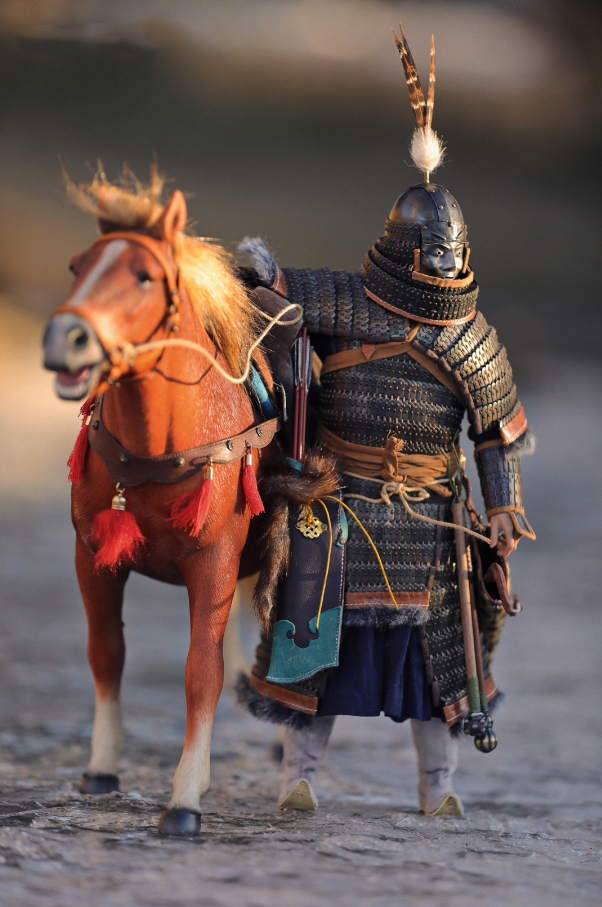
The Ming dynasty would boast 2 known examples, though 1 has far more prominence than the former. The concept of full facial protection saw a revival during the late Ming Dynasty (1368-1644 AD), an era defined by constant warfare and the proliferation of firearms. The military encyclopedia Wubei Yaolue (《武备要略》, "Outline of Military Equipment") illustrates and speaks highly of a "Full Iron Armor" (全铁甲) Detailed diagrams depict a suit of armor composed of large, plates that included a full face mask and attached neck guards.

Mask and Plates: These armors, which gave the wearer an imposing appearance of menpō - wearing samurais, featured 2 very unique qualities which were not frequently featured in Chinese armors. A protective 3 segmented metal neck guard, and cuirass that was made of pieces of pieces of plates. It was the late Ming's answer to late Ming's wars. And according to the author of the record which the armor was found, it was exquisitely resistant to bullets and all form of blows.

Diagram showing the Full Iron Armor or Quan tie jia 全铁甲 arranged in an anatomical layout (left arm guard rotated upward so as to show both the front and backside of the cuirass.) The wearer's arms would be well protected by thick segments of plates while the leg protection extends slightly beyond the knees. The Quan tie jia was not a true plate armor in the sense that there were still many openings. If anything they were more similar to the Indian Char-aina چهاﺮآﻳنه "Four Mirror" armor, Ottoman Krug, or the Russian Zertsalo armors. Despite not being fully protective as European platemails, Full Iron Armor offers significantly improved protection compared to Chinese brigandine and lamellar armors traditionally used by the Ming.

Diagrams and passage from the late Ming《武备要略》Wubei Yaolue- "Outline of Military Equipment" explains that the Full Iron Armor or Quan tie jia 全铁甲 was constructed by sewing several lacquered steel plates on layers of cotton pads, and then laced together into one form by straps. The connecting points of the cotton pads were covered with soft fabrics to prevent chafing. The author then listed the construction cost of such armors, including listing the amount of catties of high quality Fujian iron that would be needed to make a suit of armor, and the amount of coal that would be needed for the forge.
According to the author's description, this armor is not only good in protection from blows, but also difficult to penetrate with bows, arrows and firearms. What is significant about these illustrations is the detailed way in which the construction of the armor was rendered. Each segment of the armor- including the point of straps and studs were so well documented it was certain that these were not the author's fabrications but the armor was indeed either based on armors he had seen, or tried on himself.

KOXINGA'S "IRON MEN"
%20C.jpg)
铁人 "Iron Men" were the vanguards of the Ming loyalist warlord Koxinga (full name Zheng Chenggong)'s Zheng family army- a fact attested by both Zheng and Dutch sources. During the chaotic rise of the Zheng clan they were deployed extensively against both the Manchu Qing forces and also the Dutch in Taiwan.
In battle they wore very heavy bullet- proof armors made of distinctive square lamellar pieces (reverse brigandine) that looked like slates of roofs in addition, they also wore ferocious iron masks with only the eyes, ears, mouth and nose exposed, painted in colorful colors. Despite this heavy configuration, they were still able to retain great agility in battle and move with great dexterity, able to wield double bladed Pudao and horse choppers- alternatively bow and arrows with great ease. They fight in mixed formations, and are covered by other Iron Men wielding rattan shields and pikes.

"In February, the bravest men from each governor were selected as the personal soldiers, and a martial arts pavilion was built in Xiamen Port for training. Each man had to lift a stone weighing 500 jin 觔 (23 kg or 50 pounds), and 5,000 men were paraded around the training ground. The model was given to the engineering officer Feng Chengshi, who supervised the production of thick iron helmets, iron armor, arms, skirts, iron shoes, etc., which could not be penetrated by arrows. Iron masks were also made, with only the eyes, ears, mouth and nose exposed, painted in colorful colors like ghosts, and holding horse-slashing swords in their hands. Each man was assisted by two soldiers, each holding a weapon, specializing in chopping the horses' feet. They would advance and never retreat in battle, and were called iron men."
— Taiwan Waiji 台湾外记 "Taiwan Foreign Records" Vol. 4.
.jpg)
The Iron Men were also one of the elite units that afforded such a level of protection. Diverse array of arms Iron Men would have used- including rattan shields on the image left. Iron Men- similar to earlier centuries' combined arms formations operated in companies wielding a variety of weapons and shields. Aside from those wielding 2 handed choppers and bows, other Iron Men protected their advances and exposed flanks with pikes and rattan shields. As such even isolated formations under extreme pressure- including Manchu cavalry charges and Dutch bombardments- can stabilize their own situation and if needed, retreat in good order with the use of smoke bombs for cover. Because they were both archers and skilled heavy melee troops supplemented with pike wielding allies their blocks were well equipped to deal with a wide host of enemies.

QING MENTIONS


➢ ☯ Futsunomitama
➢ ☯ MK Celahir
➢ ☯ Muramasa
➢ ☯ Thomas Vieira
➢ ☯ BurenErdene Altankhuyag
➢ ☯ Stephen D Rynerson
➢ ☯ Peter Hellman
➢ ☯ SunB
.jpg)
Bonus: Yuan Dynasty faceplate: Mongol or Tibetan armor

Bonus: 14-16th Century Tibetan armored mask.


Comments