Tang Dynasty General in Heavy Armor- Qin Shubao | Qin Qiong: 唐猛将秦琼 | 秦叔宝


Action Figure: Jiao Zong Studio - 程咬金
JZMW-017 Qin Qiong 1/6 Scale Action Figure
Figure of formidable Tang founding general Qing Shubao 尉遲恭 (courtesy name Qin Qiong) in heavy guard armor. The armor (or which 3 different configurations are possible) are based on a composite of Tang imperial guardsman and general's armor. Qin Subao was one of young Tang prince Li Shiming (later Taizong Emperor)'s most ferocious warriors and played a critical part in his master's military campaigns and later~ ruthless bid for the imperial throne. He is often paired in depiction with Yuchi Gong- who are often deployed as Taizong's respective left and right vanguards.

Invaluable Leadership Asset: Endowed with supreme soldierly qualities of fearless tenacity and a high capability for independent command, Qin Qiong was able to earn the respect of a long list of patrons that he served with great distinction. Though his patron's fortunes often waxed and waned Qin Qiong was eagerly retained by them all because of his ability to deliver miracles on key fighting flanks.


Above: KOEI style portrait of Qin Shubao (Qin Qiong) - Traditional depiction of Qin Qiong often depicts him with 2 iconic sword breakers. Below: (锏 "jiǎn"- Sword Breakers) was a long quad-edged (alternatively segment ridged) sword shaped club specifically designed to break weapons with sharp edges or deal deadly bludgeon damage. The traditional Chinese weapon has a rectangular cross section with sharp corners, making it ideal to focus on damaging other weapons with brutal impact. They could be made long with a sharpened tip and at times warriors wielded them in pairs. They were quite heavy and only the strongest warriors wielded them with dexterity.


Art by Shuai Zhang. Process of a warrior donning his armor. Traditionally Chinese armor had long had its weight rested on the shoulders and held by straps. A (visually distinctive) solution to mitigate the heavy burden is to use the belt (and its wraps) to fasten the armor around the wearer's waist. Thereby more evenly distributing some of the burden. The first series of armor is based on a more rudimentary lamellar construction.


Qin Qiong- like many of early Tang's assemblage of capable veterans rose in chaos and proved themselves in the conflagration. His career- like the rest of Taizong's best officers such as Yuchi Gong and Cheng Yaojin involved rising through a nesting doll of who's who of regional warlords that absorbed each other until they were ultimately retained by the best among them all inside Taizong's capable camp.
SUI'S BRILLIANT DYING RIPOSTE- SERVICE IN SUI'S TWILIGHT
A career soldier who entered the military during the late Sui dynasty, when the Sui realm descended into anarchy during the reign of Emperor Yang of Sui: Qin Qiong made his name serving the Sui army in its twilight days.


When a major rebel army rose up under the rebel Lu Mingyue 卢明月- the imperial army that Qin Qiong served was dispatched to crush the might host. By the time the 2 armies camped set up 6 or 7 li off against each other the situation had became extremely dire. According to "Old Book of Tang" - section dealing with Qin Qiong it recorded that the rebel army consisted of some 100,000 soldiers, while the army Qin Qiong served had only 10,000 men.
.jpg)
After a dozen days of watchful weariness his commander judged that open confrontation would not yield gains- and with dwindling supplies he determined that it was best that the army pull out from their position. Yet- the enemy army would represent a major threat should they depart with the surety of being pursued in its rear. Eventually the Sui commander opted for departing with the main body of his army and bait the rebels to launch a pursuit, however they would counteract with a suicidal rearguard diversionary attack on the enemy's camp to give the impression there is an ambush. However this forlorn diversionary assault would be almost a guaranteed suicide with little hope for them to be rescued by the main retreating army. Nearly all of the other generals remained silent. But despite such seemingly impossible odds: Qin Qiong and another commander named Luo Shixin 罗士信 volunteered, with each at the head of one thousand soldiers that hid in the reeds close to the enemy camp.


As expected, when the rebels spied that the Sui army was retreating, Lu Mingyue launched a full-scale pursuit attack, and Qin Qiong and Luo Shixin seized the opportunity and sprung their sudden attack on the enemy camp. Seeing that the enemy camp gates were tightly closed and they could not enter, the two instead personally climbed up the gate tower, pulled down the rebel flags, and each killed several enemy guards. They then unlocked the camp gate and let in the ambushers from outside. They set fire to more than 30 of Lu Mingyue's camps.
Seeing the smoke from their camps, Lu Mingyue and his army rushed back in desperate haste, instead, the Sui main army at this time wheeled around and flanked in full force- crashing into the rear of the rebel army, shattering it. Lu Mingyue escaped with only a hundred or so cavalrymen, and the rest of his troops were captured. After this battle, Qin Qiong and Luo Shixin's bravery became famous far and wide. Later on Qin followed this commander to fight another rebel army's fortress and was known as the first to scale over the wall during an assault. For such suicidal bravery, Qin was promoted.


REMNANTS- SERVICE UNDER LI MI
Fortunes waned for the army Qin served when they suffered a major forest ambush of their own at the hand of the powerful regional rebel Li Mi. His commander was cornered and died in battle due to exhaustion- Qin immediately led the remnants and rejoined a remaining Sui garrison under the commander Pei Renji at Hulao Pass. It was at this time that the Sui empire completely disintegrated- one of the rebel armies, led by the Li clan (who were military governors of Taiyuan in the north) took the Sui capital of Chang'an- declaring a brand new dynasty of their own: the Tang. Later on emperor Yang of Sui was murdered by his imperial guards in the south. With the death of the Sui emperor Qin and the rest of his comrades became rudderless soldiers of a largely vanquished regime.

During this time Pei Renji had a falling out with another officer and surrendered the garrison to the rebel Li Mi- who now became a major player around the Guanzhong region of central western part of the empire. Although Qin Qiong and Li Mi crossed blades before Li Mi was greatly pleased when Qin Qiong was counted among the officers who properly surrendered to his sway. Reportedly Li Mi treated Qin cordially and even awarded him the command of 8,000 of his inner troops.

Shark Infested Waters: before Emperor Yang departed for the south, he had instructed a young son named Yang Tong- actually a kind and generous heir stay and guard the eastern capital of Luoyang. And it was there Yang Tong retained a corps of guards and ruled the vicinity of central Henan as a lone Sui rump state surrounded by a realm of rebels. His position is bolstered when an imperial guard division under the ambitious general Wang Shichong came with a rescuing army. When news travelled back north that Emperor Yang was assassinated by his guards Yang Tong was proclaimed emperor by Wang Shichong and Qin's commander Pei Renji.
At this time the Sui became a realm in full revolt, with only a holdout remnant left in the eastern capital of Luoyang- then at the command of a young teenage son of the late Emperor Yang. At this time the turncoat imperial guard army that had murdered Emperor Yang- numbering some 100,000 elite guards in full, was racing back toward the northwest which threatened both Chang'an and also Luoyang. The Sui remnant- in desperation, put out a call for allies that may parry off this threat. This approaching army just so also happened to be racing right into Qin's patron Li Mi's territory.

To avoid being attacked from both sides against this turncoat Sui imperial army AND the Sui remnant court at Luoyang, Li Mi agreed to the Sui remnants request to attack the 100,000 strong elite imperial guard army on the condition that after he win this battle he would be allowed to enter Luoyang to assist in governing as part of the new regime.
In July, the two massive armies (imperial turncoats against Li Mi's now Sui- loyalist rebels) fought a great battle at Tongshan at Liyang (modern Hebi- northern Henan Province.) The fierce battle lasted from dawn to dusk. During the melee, Li Mi was hit by a stray arrow, fell from his horse, and fainted. His subordinates all fled and he almost fell into the hands of the pursuers. Fortunately, Qin Qiong personally raced to him and defended him with his life and Li Mi escaped. After rescuing Li Mi, Qin Qiong gathered the defeated troops and fought against the rival's army. Despite the nature of the opposing side's veterancy as crack imperial guards their army collapsed and Li Mi decisively won the day.

.jpg)
Tang cataphract- reconstructed from examples based on cataphract horseman figurines recovered from Tang Prince Yide of Tang's mausoleum.
DISASTER AGAINST WANG SHICHONG
Unfortunately for Li Mi's his own ambition had new problems. His own army had been badly mauled by the confrontation, yet new problem emerged in Luoyang- inside the Sui remnant capital, Wang Shichong (the imperial guard commander who personally brought over a strong continent of guards to ostensibly aid and rescue the young emperor) usurped his patron- the young emperor was put under house arrest and Wang had multiple pro- Li Mi ministers and generals executed- including Qin Qiong's immediate superior Pei Renji. Wang then had all lever of power transferred to his immediate clansmen and after killing the deposed young emperor, made himself emperor of a new state called Zheng

Ruthless, Duplicitous, and Clever- Tongued, Wang Shichong descended from Hu (none- Han western) ancestors- likely of Sogdian (Yuezhi) ancestry and his clan were professional imperial guards. When the Sui realm descended to chaos, he led a strong detachment of imperial guards and raced to the eastern remnant at Luoyang and ingratiated himself to the grateful young emperor. The young emperor soon rapidly conferred him many honorifics upon him including the Duchy of Zheng.

However he soon became jealous of the Emperor's new rapport with Li Mi. Thus after Li Mi's victory Wang had the young emperor deposed in a coup. All of the pro- Li Mi ministers in the capital were slaughtered. In 619, after forcing the teenager to bestow him key imperial titles and ceremonial honors, Wang forced the young former emperor to commit suicide by drinking poison. When the poison did not work, Wang's cousin ordered that he be strangled to death. Immediately after, Wang declared himself Emperor of a new dynasty called Zheng- based on the name of his duchy.
THE BATTLE OF YANSHI

The coup at Luoyang meant Li Mi and Wang Shichong now became inevitable rivals. Li Mi soon lead his recently victorious army of some 40,000 to confront Wang. The major confrontation (of 2 of the strongest players in the Henan Central Plains) became a disaster for Qin Qiong. Li Mi became arrogant and conceited because of his victory, because of contempt for Wang Shichong, when he camped to confront Wang's army he did not bother to build fortifications.
Music: Fury, Hammer, and Tongs
Wang Shichong took advantage of this and at night redeployed a large wing of his army that snuck near Li Mi's flank and launched a surprise attack at dawn, defeating Li Mi at the foot of Mangshan Mountain.


After his crushing defeat, Li Mi was afraid of retaliation from other rivals so he fled west to Chang'an and joined the newly established Tang regime under Gaozu Emperor of Tang Li Yuan . Qin Qiong was captured in the battle and temporarily joined Wang Shichong- who also owing to Qin's reputation retreated him as a value asset. Despite being supplied with promotions Qin despised Wang.

Though Wang treated Qin lavishly, Qin and his able comrade Cheng Yaojin- who was also suicidally brave, in the previous battle when the flank of Li Mi's camp was overwhelmed in the dawn assault and Cheng's personal friend- the commander at the unfortunate contact point was fully encircled Cheng personally rode into the enemy choked camp and carried his friend from battle on his own horse. Both Qin and Cheng survived the battle and were treated lavishly by Wang. However both fearlessly brave commanders utterly despised Wang.
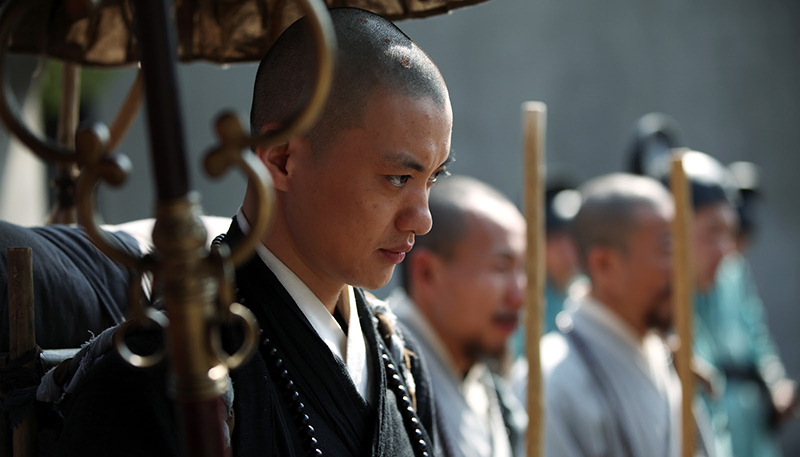
Wang's sheer unlikability extended even to unexpected spheres- the Shaolin monks of Henan also rose up against the Wang clan after the Wangs began to confiscate monasteries in order to supply the Zheng state's treasury. These monks also joined the Tang in fighting the Zheng threat thereby heralding their first major moment of renown in Chinese history.

Prince Li Shimin's congratulatory letter insscribed on a Shaolin stele.
SERVICE UNDER TANG
In February 619, Qin Qiong, disgusted by Wang Shichong's treacherous nature, along with Cheng Yaojin and others, defected to the Tang camp while the Tang and Zheng armies were facing off at Jiuqu- bringing all of their men with them in tow. Emperor Gaozu of Tang, Li Yuan, arranged for him to serve in the household of his dynamic 2nd son, Prince Li Shimin. Li Shimin had long heard of Qin Qiong's bravery and treated him with great respect, granting him the position of Commander-in-Chief of the Cavalry.

The young Warrior Prince Li Shimin- the Prince of Qin, and future Taizong 太宗 Emperor of Tang (598 – 649). Decisive and tolerant, two traits that defined Li Shimin. A cerebral and charismatic leader, he was able to persuade most of his enemies to work for him and become key parts of his imperial cabinet. During his reign Tang became the undisputed Hegemon on East Asia and entered into a Gold Age. Arguable the best Tang Emperor along with Xuanzong who presided during the High Tang era (713-766.) In his youth- then known as the Prince of Qin (a fief awarded in the West) he personally defeated several of Tang's most dangerous foes while leading from the front.

Ming dynasty portrait of Taizong Emperor which the KOEI portrait is almost definitely based on, note the almost exact similar collars and embroidered cloud and dragon motif of his emblem.
MIRACLE AT HULAO

2 Configuration of helmet- the latter with cheekguards and neckguard flaps pulled up and wrapped around the fenial of the helmet.

In July of 620, after rapidly putting down a major revolt in the flank of the Tang army with Qin at his side, Li Shimin raced his army to Luoyang to attack Wang Shichong, always using Qin Qiong as his vanguard.
It became immediately apparent that a war between Wang Shichong and Tang would decide the fate of the Central Plains- but to Tang's major disadvantage: Wang's eloquent brought forth whole new disasters from the east. When the Tang army under Li Shimin quickly surrounded Luoyang- another army marched on Henan as an ally of Wang- a rebel army of some 100,000 under the command of the charismatic rebel general of Hebei Duo Jiande.
The Tang army- which was already comparatively undermanned and only a fraction of the size of Duo's army, is left with a major conundrum: either abandon the siege against Luoyang and retreat thus risking being flanked, or wait and be crushed between Duo's huge rescuing army and Wang's sallying forces. Li Shimin did the unthinkable, he left most of his forces to maintain the siege at Luoyang, while riding off with an elite detachment to the Hulao Pass directly in the path of the deathball of Duo's forces.
MIRACLE AT HULAO
%20(1).jpg)
.jpg)
%20(1).jpg)
Hulao was one of Li Shimin's most lopsided battles, with him reportedly having only 3,500 soldiers Taizong (conservatively still less than 10,000- Li Shimin's core + local levies) faced against an arriving enemy some 100,000 strong. In the narrow Hulao pass, Li Shimin nimbly harassed them with superior Tang cavalry and then, while the enemy army began to loose cohesion, the Tang made a deep attack charging directly into the center of the sweltering enemy camp.


During the decisive penetration attack right into the heart of the enemy camp under the Blacks- Li Shimin's crack guard of his best cavalry all distinguished by their jet black armor, Qian Qiong and Cheng Yaojin directly followed Li and completely overwhelmed the enemy camp. The eviscerating attack caused major panic in Duo's army and it began to route.

.jpg)
The elite Blacks, or "Black Armor Army" / "Jet Black Armor Army" 玄甲军. As an elite unit they were stockpiled of Li Shimin's best warriors and tactical officers. They were all distinguished by their jet- black armor.
The deep attack against the larger army caused a severe ripple of panic from the larger host and its morale began to collapse in pieces then all together. Soon the entire enemy army was routed and its commander captured. The battle captured surrendered enemies in the high tens of thousands. Li Shimin did not relent his pressure, and took the victorious army to Luoyang, the defenders, seeing their reinforcement have been shattered and its ally army commander captured- broke and the city surrendered.

Li Mi, Wang Shichong, Duo Jiande were all executed or conveniently assassinated by Li Yuan. Li Mi- after attempting to break off from Li Yuan was cornered, Duo was executed, and Wang- although Li Shimin gave personal promise he would be spared, his father Li Yuan- while Wang and his brothers were being escorted to their imprisonment- had them killed by a rival family that had been harmed by the Wang clan in the past. By this point, the most dangerous internal rivals of Tang were all removed.

For his decisive contribution as part of the vanguard of the blacks- according to the Old Book of Tang, he was granted the title of Duke of Yi and was rewarded with 100 catties of gold and 7,000 bolts of silk.
Hulao ensured that 2 major rival factions against the burgeoning Tang hegemony were crushed in one fell swoop and 2 armies- both far larger than Li Shimin's own were both broken and their strength now augmented under the merciful Tang banner. Hulao ensured from that point on, Tang supremacy (which previously had only been a rebellion that captured the Sui capital)- is secured. As a measure of class, and perhaps his character, decades after the battle was over in 629, Li Shimin, by then the new Taizong Emperor, ordered the erection of Buddhist monasteries on the sites of seven of the battles he had fought during the civil war. For Hulao he chose the name "Temple of Equality in Commiseration" in tribute and commiseration for soldiers of all sides that fell in this battle.
LI SHIMIN'S IMPERIAL COUP
.jpg)
.jpg)
Qin Qiong- despite being one of Tang's instrumental vanguard generals in over a dozens of headlong battles at the head of the army- eventually found himself in danger upon Li Shimin's triumphant return. Threatened by his success- Prince Shimin's elder brother (the crown prince) and his younger brother both maneuvered against him. They actively slandered against him and persuaded their father to deploy the "blacks" away.


.jpg)
In one of the more violent episodes upon returning from his older brother's banquet Li Shimin became violently ill and began to vomit and was bed ridden for days. Fearing that he has been poisoned, his remaining loyal retainers and advisers rushed to him. His close followers- including Yuchi Gong, Cheng Yaojin, Qin Qiong rushed to him, pleading with them to launch the first strike, arguing that if he hesitates, they too would be slain as well as part of his staff. Swayed, his young master took heart. On the pre-dawn hours of 2 July 626- when Li Shimin's 2 brothers were summoned for an attendance with their liege father in court, when they came near the Xuanwu gate to the imperial palace, they were ambushed. Li Shimin and Yuchi Jinde personally finished off the 2 princes and secured the premise.


By dawn- the gate- and the rein of power was in Li Shimin's hands. His father Li Yuan was still holding pre-morning session with his ministers when reportedly disturbances and distant commotion were reported back to them. When Yuchi Gong personally appeared- in full armor and armed (this was extremely illegal as possession of arms and armor were strictly forbidden except for imperial guards) Gaozu and his ministers understood something terrible must have had happened, when the emperor inquired what had happened Yuchi Gong coolly replied that the 2 princes had been plotting treason and were dealt with.


Action Figure: JiaoZong Model Tang Dynasty Horse's Armor 1/6 Accessories Black WF2024
(Above) cataphract horseman figurines recovered from Tang Prince Yide of Tang's mausoleum. The rider's horses have gilded chanfrons (horse head armor) and have peacock plumes surmounted on their lamellar helmet.
Guessing the reality of what had happened the ministers persuaded Gaozu to name Li Shimin the crown prince and then retire. Gaozu therefore hastily retired and passed the throne to his son. The Xuanwu Gate Incident was one of the most controversial incidents in Li Shimin's career and early Tang's history, yet Qin Qiong still played a part in it- ensuring his newly enthroned patron's appreciation. Afterwards, he was appointed General of the Left Guard and granted a fief of 700 households.


With the conclusion of the Xuanwu Gate incident, Taizong's rule within the empire was largely secured. Later, Qin Qiong often fell ill, and whenever he was sick, he would say to others, "I have spent my life on the battlefield, experiencing more than two hundred battles, large and small, and have been seriously wounded many times. I have lost several bushels of blood. How can I not fall ill!" In 638, Qin Qiong died of illness and was posthumously awarded the title of Governor of Xuzhou and buried in Zhaoling- Taizong's own complex. Li Shimin specially ordered the construction of stone figures of men and horses in front of Qin Qiong's tomb to highlight Qin Qiong's military achievements. In time he would be remembered as one of the most meritorious of early Tang's generals.

Qin Qiong would also achieve a degree of cultural immortality. Later on he would be honored as a Door God 门神, and is frequently depicted, along side his friend Yuchi Gong- another key bodyguard of Li Shimin as defenders of hearth and home on 2 sides of doors of traditional Chinese houses.


➢ ☯ Futsunomitama
➢ ☯ MK Celahir
➢ ☯ Muramasa
➢ ☯ Thomas Vieira
➢ ☯ BurenErdene Altankhuyag
➢ ☯ Stephen D Rynerson
➢ ☯ Peter Hellman
➢ ☯ SunB


Comments
Mitten gauntlets
https://www.patreon.com/posts/auxiliary-of-74007966
Speaking of which- I remembered you long asked me about banners and vexillology of ancient and medieval Chinese armies:
I found a large compendium full of them from across the various eras and in image form. The quality are not so great but you will get a buffet of sort. Just turn on translate and you can read it.
https://zh.wikisource.org/wiki/%E6%AC%BD%E5%AE%9A%E5%8F%A4%E4%BB%8A%E5%9C%96%E6%9B%B8%E9%9B%86%E6%88%90/%E7%B6%93%E6%BF%9F%E5%BD%99%E7%B7%A8/%E8%80%83%E5%B7%A5%E5%85%B8/%E7%AC%AC160%E5%8D%B7